When to Go to Kyrgyzstan — the Best Month for Each Activity
The honest answer is: it depends what you're coming for. Here's the resident version — by activity, by month, caveats included.
Last reviewed:
The honest answer to "when should I go?" is: it depends what you're coming for. Skiing in July is as wrong as a Song-Kul yurt in April — so this page works activity by activity, with the caveats I'd give you in person. Seasons themselves are stable; festival dates and the World Nomad Games are year-specific, and those are marked accordingly.
What is the single best month to visit Kyrgyzstan?
If you force me to pick: July and August for the high mountains — every pass is open, the yurt camps are running, the lake is warm enough to swim in. But if you ask me when I take my own trips: September. The trails are still open, the pastures turn golden, the crowds go home, and the weather holds stable through the middle of the month. That's the honest, unhedged answer — everything else on this page is about matching the month to what you actually want to do, because "Kyrgyzstan" in January and "Kyrgyzstan" in July are two different countries.
Quick answer
June–September opens the widest range of summer travel. July–August is strongest for high passes. Winter is for skiing, not high trekking.
The month-by-month activity matrix
Read it row by row: find your month, see what's possible. Compiled from operator-published seasons and official sources in July 2026; hunting dates are outfitter-published and pending confirmation against the official season decree (2025 rules also add nationwide Tuesday/Wednesday "quiet days").
| Month | Trekking | Song-Kul yurts | Issyk-Kul swimming | Skiing | Eagle hunting | Ibex/argali hunting | Cultural touring | Caveats |
|---|---|---|---|---|---|---|---|---|
| January | No (high mountains); valley walks only | Closed (winter expedition camp only) | No — lake ice-free but cold; winter birdwatching | Yes — all resorts | Real hunting season | Ibex window re-opens mid-Jan | Yes — cities, valleys | Torugart/Naryn roads can close |
| February | No | Closed (winter camp only) | No | Yes — peak snow | Real hunting season | Ibex — good month | Yes | Extreme cold at altitude |
| March | Low valleys only; mud starts | Closed | No | Season ends mid–late Mar (Too-Ashuu into Apr) | Season tail | Closed (outfitter windows end ~1 Mar) | Yes | Mud season begins |
| April | Low-altitude only; mud | Closed (some families move up late Apr, weather-dependent) | No | Too-Ashuu tail only | Demonstrations possible; no real hunts | Closed | Yes — canyons, south shore | Roads muddy, some impassable |
| May | Low–mid altitude from mid-May; wildflowers | First camps late May; mud on approach | No — water cold | No | Demonstrations possible | Closed | Yes — good month | High passes still snowed in |
| June | Season opens; high routes from mid-Jun | Open from early/mid-Jun; nomad migration (köch) | Beach season starts; water still cool | No | Demonstrations possible | Closed | Yes — excellent | Late snow possible on high passes |
| July | Peak | Peak; horse games (kok-boru) | Peak, 20–23 °C | No | Demonstrations; festival season builds | Closed (opens 15 Aug) | Yes | Busiest month — book ahead |
| August | Peak | Peak | Peak, 22–24 °C | No | Birds of Prey & Salbuurun festivals (early Aug) | Ibex + argali open 15 Aug | Yes | World Nomad Games 31 Aug–6 Sep 2026 |
| September | Excellent until mid-Sep; high routes tail off | Winds down; camps close mid–late Sep | Until early/mid-Sep | No | Demonstrations | Prime ibex/argali months begin | One of the best months | Song-Kul road tricky after mid-Sep |
| October | Low-altitude only; autumn conditions | Closing/closed — first snow can shut the road | No | Too-Ashuu from late Oct | Real season approaches | Prime argali; ibex | Yes — lowlands pleasant | Rain; snow on high trails |
| November | No (high); valley walks | Closed | No | Resorts open late Nov–mid Dec | Real hunting season begins | Ibex/argali prime ends ~30 Nov–7 Dec | Yes | Winter driving conditions begin |
| December | No | Closed (winter camp opens) | No | Season opens mid-Dec | Real hunting season | Outfitter windows closed Dec–mid Jan | Yes | Deep winter in high country |
When is trekking season?
June to September, with mid-June to mid-September the most reliable window — trails clear of snow, passes open, rivers lower after peak snowmelt. High routes can hold snow on the passes into July, while lower hikes are feasible from mid-May, which is also peak wildflower season. Some operators push into October, but autumn conditions can arrive any time after mid-September. A few headline routes have their own tighter windows — Kel-Suu, for instance, is best July to September, with snow or flooding often limiting access outside those months. What we run in that window is on the guided trekking and horse trekking pages.
When can I do the Ala-Kul trek?
Mid-June to early October, with July–August the most popular — the pass (3,860 m) can hold snow early and late in that window. Full route notes are on the Altyn Arashan & Ala-Kul page.
And in the south (Alay/Lenin Peak)?
July to mid-September — the season is shorter and colder at altitude, with daytime temperatures around +5 to +15 °C up high. Details on the Lenin Peak & Alay page.
When can I stay in a yurt at Song-Kul?
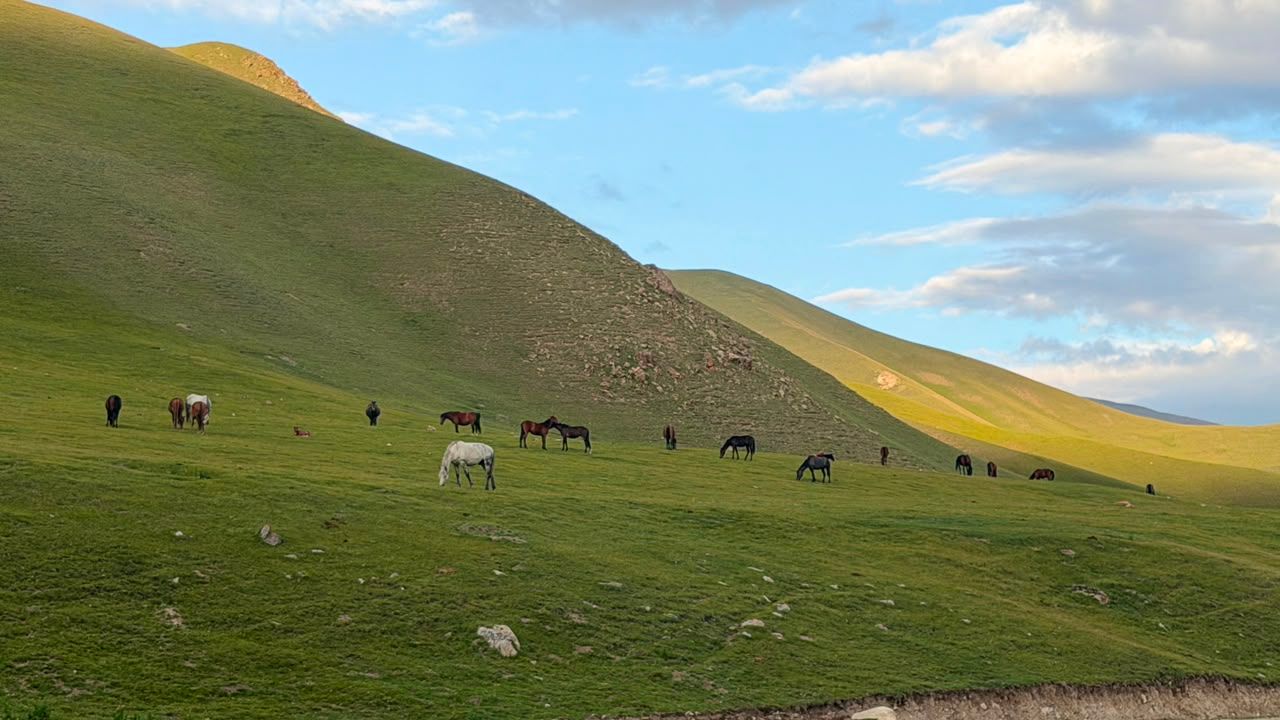
Practically, mid-June to early September. Camps open in June (one camp publishes 4 June–28 September — illustrative, not universal) and pack up when the season turns. The rhythm inside that window: June brings green meadows and the nomad families arriving on the summer migration (the köch); July and August are peak season, with community horse games and the best light; September turns golden and quiet, but road conditions can deteriorate after mid-month. May is mud season on the approach, and the access road over Kalmak-Ashuu pass (3,447 m) can close with the first October snow. You need a high-clearance 4WD — sedans don't make it. Route and season details are on the Song-Kul page. One niche exception exists in the market: a winter expedition camp near the frozen lake, December–April, reached by hours on horseback in serious cold. It is not a standard product on this site — if a winter expedition is what you want, write to me and I will tell you honestly what is possible.
When can I swim in Issyk-Kul?
June to early September, with July–August the high season: the water reaches 20–24 °C, warmest in the north-shore shallows around Cholpon-Ata, which is also the main developed beach hub — less windy, better sand. The south shore is quieter and less developed. The lake never freezes — its slight salinity and sheer mass keep it open all winter, which is exactly what its name means: "warm lake". I grew up on these shores, so my honest advice: swim in July and August, and walk the nearly empty beaches in May and October. Shore-by-shore detail is on the Issyk-Kul page.
When is the ski season?
Resorts run mid-December to late March; Karakol runs longer (December–March, some years into April) and Too-Ashuu, on the Bishkek–Osh road, runs roughly late October to April, while most smaller resorts (Chunkurchak, Kashka-Suu, ZiL, Orlovka) stick to late December–mid-March. For ski touring the window is mid-November to early April, with the best powder January–March around Karakol and Jyrgalan. One thing the dates don't tell you: the continental snowpack here builds weak, faceted layers, so avalanche assessment matters more than the month — that's a guiding point, not a calendar entry, and it's on the winter ski touring page.
When can I see eagle hunting?
Three different things get blurred here. Demonstrations with a berkutchi and his bird are bookable year-round near Bokonbaevo on the south shore. Genuine hunts happen in the cold months — late autumn through winter, when fox fur is prime. And the big public festivals — Birds of Prey and Salbuurun — are early-August events (10 August and the start of August in 2025; dates are confirmed annually, so check with us). Falconry has been on UNESCO's Intangible Cultural Heritage list, Kyrgyzstan included, since December 2021. The 2026 anchor is the World Nomad Games, 31 August–6 September 2026 — opening in Bishkek, main competitions at Cholpon-Ata and the Kyrchyn Gorge on the north shore. More in the eagle hunting journal and on the Bokonbaevo page.
When is hunting season?
Outfitter-published seasons open 15 August: ibex runs to around 1 March (best mid-September to mid-November, plus a February window), argali to early December (peak October–November). These dates come from outfitter listings, not the official season decree — confirmation against the legal text is still pending — and the revised 2025 hunting rules add nationwide Tuesday/Wednesday "quiet days". It is the autumn–winter counterpart to summer trekking, conducted at 3,000–4,000 m; context and the ethics-first framing are on the hunting expeditions page.
What about spring and late autumn — the honest shoulder seasons?
April–May is mud season: melting snow brings wildflowers and high rivers, rain turns country roads to mud and can make them impassable, and the high country effectively stays closed until June. But it's a good window for canyons, waterfalls and the south shore. Late September–October is the opposite story — golden, quiet, stable; lowland travel stays pleasant into October while the first snow shuts the high roads. Autumn is also rainier than summer, and the high water levels suit rafting and kayaking. We'd rather tell you this now than strand you at a pass — shoulder-season trips are possible, they just need honest routing, which is what our cultural tours and eco tours are built around.
Does the climate differ across the country?
Yes — three different worlds. The Issyk-Kul basin is moderated by the huge non-freezing lake: January averages −3 to −7 °C, July +17 to +23 °C at lake level, and moisture increases from west to east — the Karakol side is greener than the dry western shore. The high mountains are harsher: at Song-Kul (3,016 m) even midsummer days run 14–22 °C with nights of 5–10 °C, and mid-winter drops to −20…−25 °C. The south (Osh and the Alay) is the country's warmest zone with a longer season — though its high-mountain trekking is still altitude-limited to July–mid-September.
Choose by activity
The same month does not suit every trip.
| Activity | Most reliable window |
|---|---|
| High trekking | July—August |
| Horse travel and yurt camps | Late June—early September |
| Issyk-Kul and lower routes | May—October, depending on activity |
| Ski touring | December—March |
Use the shoulder months carefully
June and September can be quieter and beautiful, but high passes, camps and late-season roads are less predictable.
Confirm close to travel
Snow, storms and road work do not follow a fixed calendar. Recheck remote access and seasonal stays in the same week.
Sources
- Visit Kyrgyzstan — when to visithttps://www.visitkyrgyzstan.org/when-to-visit/
- Kyrgyzstan Planner — seasonshttps://kyrgyzstanplanner.com/best-time-to-visit-kyrgyzstan/
Contact
Tell me your dates and what you want to do — I'll tell you honestly whether they work, and what I'd swap if they don't. Entry rules are on the entry rules page.