
Eco journeys
Slow travel through lakes, valleys and summer pasture.
A flexible private trip for travelers who want landscapes, village life and time outdoors without a demanding trekking schedule.
- Fitness
- Easy
- Season
- May—October
- Duration
- 4—7 days
- Region
- Issyk-Kul, Song-Kul, Sary-Chelek
Nature without rushing the country.
These journeys use short walks, scenic drives and locally run stays. The route follows the season rather than a fixed checklist.
Good for
- First visits and mixed-ability groups
- Families and travelers who prefer short walks
- Photography, local food and quiet lake country
Not for
- A summit-focused or high-pass trekking objective
- A fast itinerary covering several distant regions
Three ways to shape the journey.
Choose one anchor or combine two when the driving time remains sensible.
Issyk-Kul south shore
Canyons, villages, yurt stays and eagle-hunter traditions with mountain access nearby.
Song-Kul pasture
High open country, yurt camps and optional gentle horse riding in summer.
Sary-Chelek west
Protected forest, mountain-lake scenery and a slower route away from the main circuit.
What to expect
Stays
Guesthouses and seasonal yurt camps, chosen around the route and your comfort level.
Pace
One or two main experiences per day, with room for weather and local stops.
Conditions
Mountain roads and camps change with the season; the final route is confirmed close to travel.
What is an eco tour in Kyrgyzstan?
An eco tour here is not a certificate on a wall — no Kyrgyz operator holds a meaningful eco-certification, and I won’t pretend otherwise. What it means in practice on my trips: small private groups instead of busloads, nights in shepherd-run yurt camps rather than new-built hotels, reserve rules followed to the letter, and money going to the families who host you. The model follows Community Based Tourism principles — the CBT network unites 17 community groups across the country, and its association reports that roughly 80–85% of what travellers pay through CBT reaches host families, guides and drivers (KCBTA 2023 overview, as cited July 2026 — an indicative figure, not an audited one). I grew up on Issyk-Kul’s shore; the pastures and lakes these tours visit are where my own people spend their summers, and I’d like them still worth visiting in twenty years.
Which places do eco tours visit?
Three kinds of country: a UNESCO biosphere reserve in the western Tien Shan, a high-altitude wetland lake, and the summer pastures in between. Here is why each one earns its place on the route.
Why Sary-Chelek?
Sary-Chelek Biosphere Reserve is the green counterweight to Kyrgyzstan’s high, dry plateaus. The reserve was created in 1959 and joined UNESCO’s World Network of Biosphere Reserves in 1978. Its main lake sits at roughly 1,880 m — sources disagree on the exact figure (1,873 m in some, 1,887 m in others) — and drops to over 230 m deep, one of the deepest lakes in the country. Six smaller lakes hide in the folds around it. The slopes carry natural walnut-and-fruit forest — walnut, wild apple, wild pear — and the reserve is home to around 40 mammal species, including bear and lynx.
It is also a place with rules, and the rules are the point. Swimming is prohibited in the reserve’s lakes; fishing, hunting and plant collecting are banned; camping is allowed only at designated sites. Foreign visitors pay a small entrance fee, plus a per-tent charge at the official campsite — I recheck the current figures every season — and rangers check receipts at the lake. On my tours this is not fine print. It is how a biosphere reserve stays one.
Why Song-Kul?
Song-Kul is a different kind of lake entirely: 3,016 m above sea level, about 270 km² of fresh water ringed by mountains on every side — the second-largest lake in Kyrgyzstan after Issyk-Kul, and the largest freshwater one. It is a Ramsar Wetland of International Importance, designated in January 2011, and the birdlife is why: demoiselle cranes and bar-headed geese breed here. One thing it is not — a few websites claim UNESCO attention for Song-Kul. I could not verify that anywhere, so I don’t repeat it.
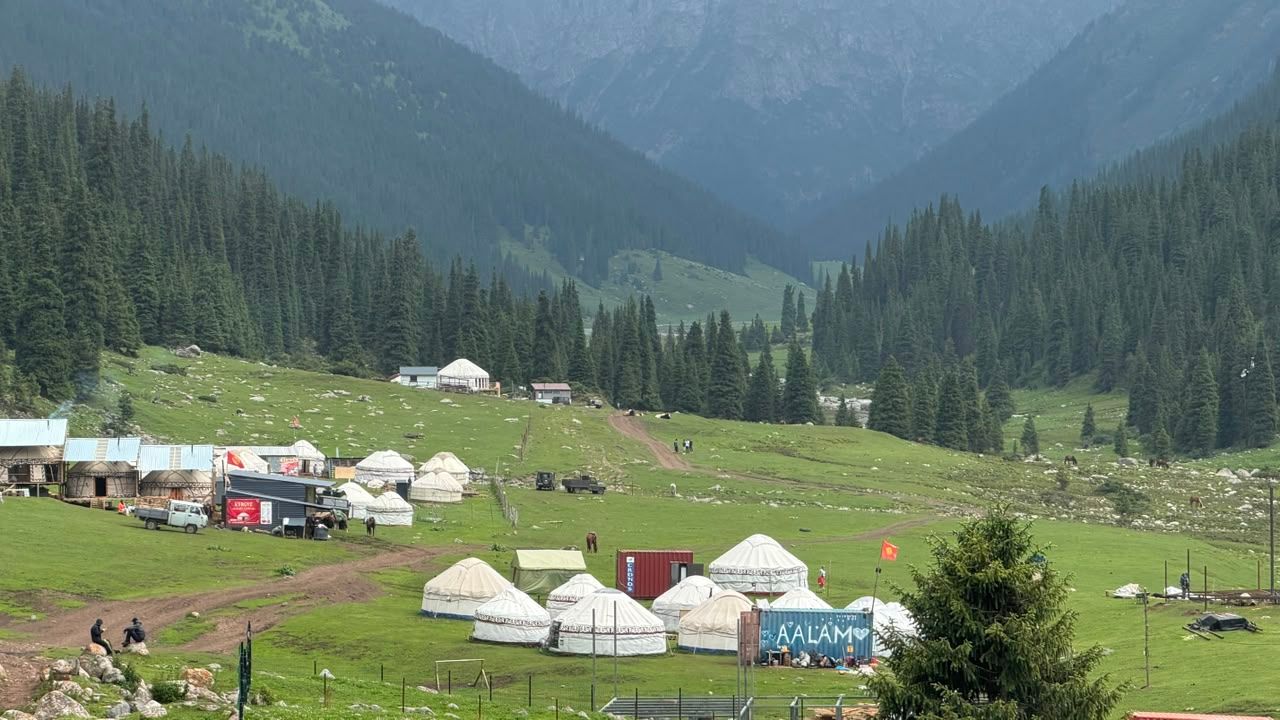
There are no permanent buildings at Song-Kul. None. What you stay in is what the shepherds live in: family yurt camps that go up with the herds in June and come down by mid-September. And it is cold — honestly cold. The July average temperature at the lake is only +11 °C, nights drop to freezing even in midsummer, and snow can fall on the passes in July. I will tell you to bring a proper sleeping bag and full layers, and I mean it. In exchange you get a night sky with zero light pollution and mornings when the only sound is horses leaving camp.
What is jailoo life?
Jailoo is the Kyrgyz summer. When the high valleys green up, families move their herds — and themselves — to pasture and live in yurts until the grass and the weather say stop. A family camp is typically three or four yurts. You sleep on thick quilts laid on the floor around the stove, drink kumis (fermented mare’s milk — the mares are milked five or six times a day), watch felt being made, and eat what the family eats. Expect pit latrines, no running water, little or no electricity, and no phone signal or wifi. Some travellers read that list and choose something else, which is fine — better to know before than after. The ones who come usually call it the part of the trip they still talk about years later.
How do we keep it low-impact?
Four working rules, nothing mystical. Small groups — private trips, never a convoy. Existing trails and designated campsites only — Sary-Chelek’s published rule set is the model. Shepherd-run camps and family guesthouses, so the money stays in the valley. And everything we carry in, we carry out. Low-impact travel here is less about gear and slogans than about moving through places the way the people who live there do.
When can you go?
| Place | Season | Honest notes |
|---|---|---|
| Sary-Chelek | May–October | July–September is busiest; the famous autumn foliage runs mid-September to early November — locals say the lake’s name (“yellow bucket”) comes from that gold, though the older telling involves a beekeeper’s honey barrel. Winter access is unreliable; snow closes the road. |
| Song-Kul | June–early/mid-September | Camps fully running July–August; shepherds descend by mid-September and the shore is empty by the end of the month. The Kalmak-Ashuu pass road was officially closed from 6 November 2025 by district order — a concrete marker of when the season truly ends (2025-season fact, rechecked annually). |
| Jailoo camps generally | June–September | Exact set-up and strike dates vary by camp and by snow year — I confirm the specific camps we use for your dates before you book. |
For the month-by-month picture across every activity, see when to go.
What does a sample eco tour look like?
Sample itinerary — final program tailored on inquiry. Most eco trips run five to seven days. A typical six-day shape: Bishkek to Kochkor, over the pass for two nights at a Song-Kul yurt camp, then down to Issyk-Kul’s south shore for two slower nights and back. The western version swaps in Sary-Chelek — and I tell you up front that reaching it from Bishkek takes the better part of a day, around nine hours by road via Tash-Komur to Arkit, the gateway village. That transfer is part of the journey, not a detail to hide. The day-by-day below is a starting sketch; tell me your dates and I’ll shape the route. For route logic by trip length, the 7, 10 or 14-day itinerary notes are a good companion read.
How fit do I need to be?
Eco tours are the gentlest tier of what I run. The walking is day-walk scale: the gate-to-lake walk at Sary-Chelek is easy to moderate (about eight hours round trip if you walk the whole 17 km dirt road each way — most guests ride up and walk the scenic parts), and the Seven Lakes walk above the reserve is roughly 11 km and four hours, easy. Nothing requires trekking fitness, and there is always a vehicle or a horse if your knees disagree with the plan. If you’d rather cross the pastures in the saddle than in a seat, the same country works on horseback — see horse trekking.
How much does it cost?
No fixed prices on this page — every trip is quoted on inquiry, because group size, season and route move the number. For orientation: Song-Kul yurt camps come in broad tiers, from simple shepherd camps through mid-range to the most comfortable CBT-style setups, and I reconfirm real prices with the camps every season before I quote. For the wider picture — transport, food, guide day-rates — ask when you inquire and I’ll share the current figures.
How do I book?
Message me on WhatsApp or use the contact form — send your dates, your group size and a rough idea of what you want, and I reply personally with a program and a price. Nothing is fixed until you approve it.
Plan this trip — send your dates
I read every inquiry myself and reply with questions, then a draft program.
Thank you — we will reply soon.
You can also say hello on WhatsApp — it's often the fastest way to reach me.