Destinations
Jyrgalan, with enough time to understand the place.
Community valley trails in summer and lift-free winter snow.
- Season
- June—September; January—March
- Base
- Karakol
- Pace
- 2—4 days
Go for the place—not only the landmark.
The strongest visit leaves room for local conditions, short walks and the road itself.
- Use one practical base instead of changing hotels every night.
- Match outdoor plans to the season before fixing transfers.
- Leave margin for mountain roads, weather and unplanned stops.
Build a route that still feels like a journey.
Pair nearby places before adding another distant region.
Karakol
A sensible companion when dates and road conditions allow.
Altyn Arashan
A sensible companion when dates and road conditions allow.
Issyk-Kul
A sensible companion when dates and road conditions allow.
What to decide before you go
Access
Mountain roads take longer than the map suggests; confirm the current approach.
Stay
Choose the base around the next day's activity, not only the best-known town.
Conditions
Weather, road work and seasonal camps can change the final plan.
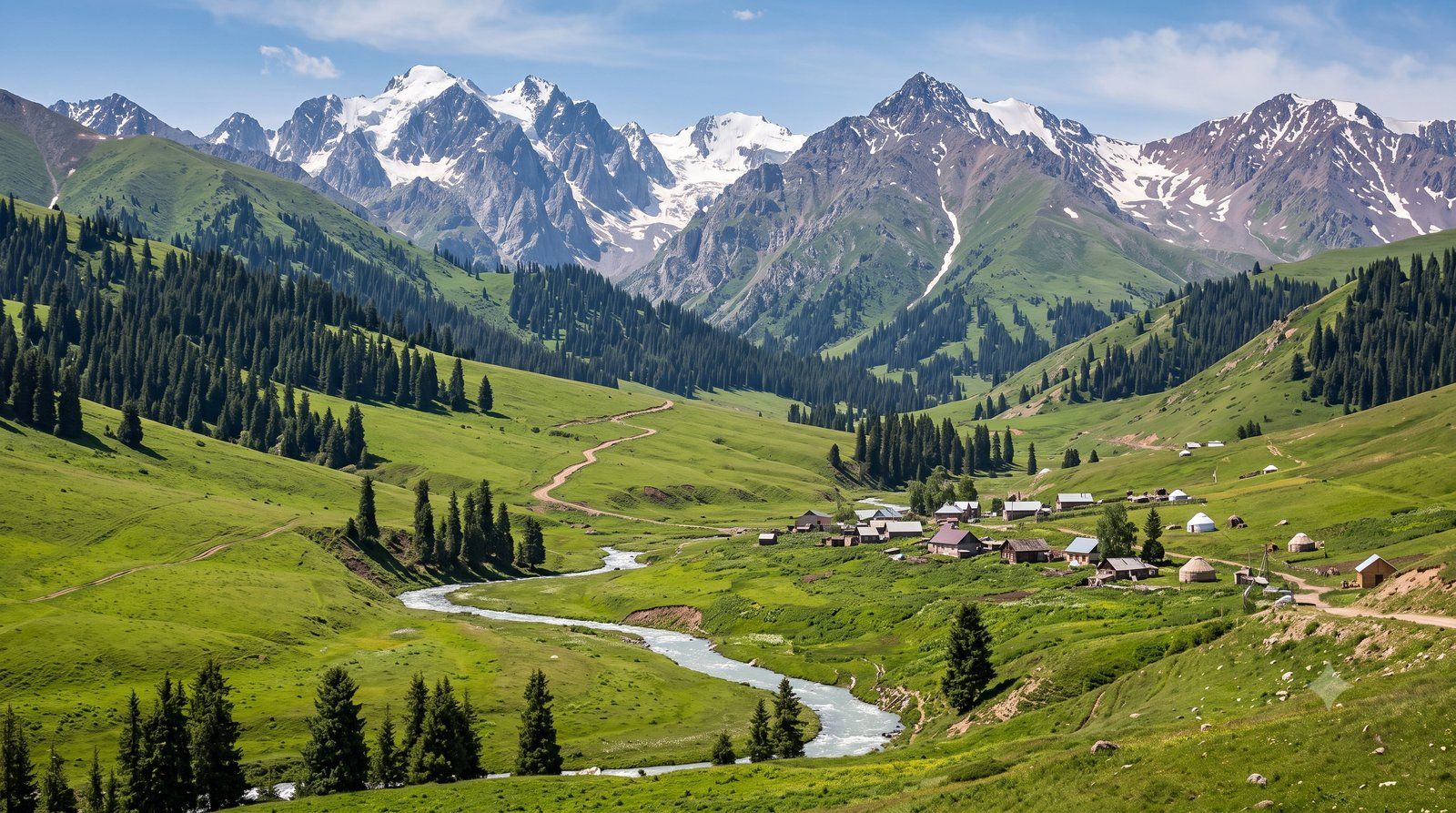
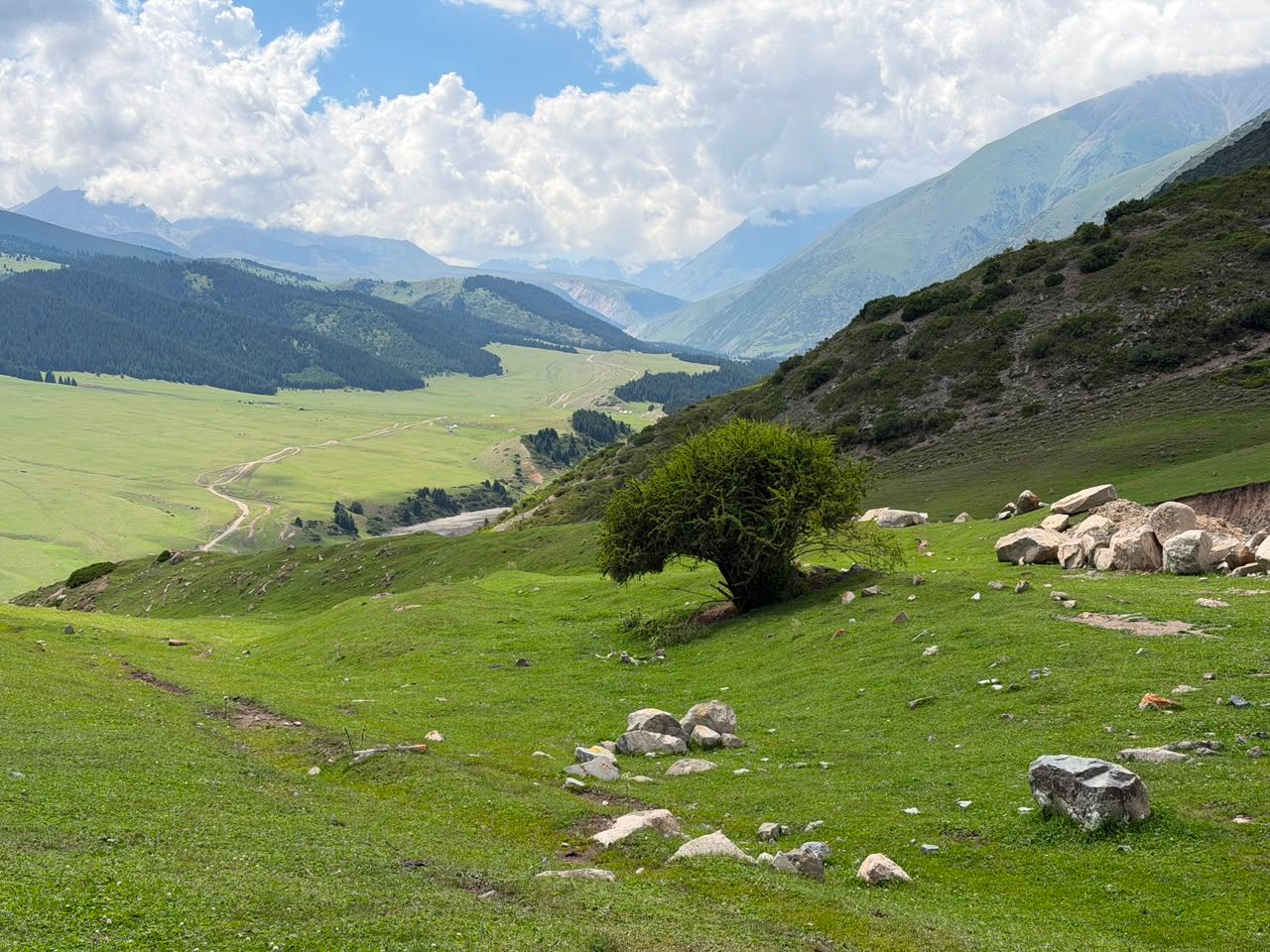
Jyrgalan is a small village in a wide green valley an hour east of Karakol, and it’s two destinations in one: from late June to mid-September it’s a trekking and horse-riding base with marked trails starting at the edge of the village, and from December to April it’s a freeride ski valley with no lifts at all — just snowcats, snowmobiles and your own legs. The name translates as “bliss” or “happiness,” and the story of how the village earned its current reputation is worth knowing before you come.
What is Jyrgalan?
Jyrgalan is a village at about 2,250 m in the eastern Terskey Ala-Too mountains, roughly 60 km — about an hour by road — from Karakol, the base town an hour west. The Jyrgalan River runs through the valley and down to Issyk-Kul; it’s one of the two largest rivers feeding the lake.
The village was founded in the 1930s as a coal-mining settlement, and when the Soviet economy collapsed after 1991 the mines and factories closed and people began to leave. What happened next is why travelers know the name: instead of emptying out, the village rebuilt itself around community tourism. Destination Jyrgalan Valley, the local destination-management organization, runs as a non-profit in which every tourism business in the village operates as a social enterprise, returning a share of profits to community projects. Its central booking office handles tours, accommodation, guides, gear rental and trekking maps in one place.
The human version of that story is the Rahat Guesthouse: in the 1990s its owner was the village’s only police officer, watching the factories shut down one by one. Today he hosts trekkers and skiers from all over the world. When you stay in Jyrgalan, the money stays in Jyrgalan — that’s the model, stated plainly, and it’s why I like sending people there.
What can I do in Jyrgalan in summer?
Summer here runs from late June to mid-September, and the differentiator is simple: the trails are marked and mapped, which is not something you can say about most of the Kyrgyz backcountry. That makes Jyrgalan the best valley in the region for independent hikers, and a comfortable base for guided days too.
Which day hikes start from the village?
Three walks cover most day-hikers. The Kok-Bel waterfall trail is about 6 km from the village to a 20-metre waterfall, strongest after rain or in late spring. The Turnaly Kol panorama is a roughly 10 km beginner-friendly loop past a small alpine lake, with views toward the Kazakhstan border on clear days. And Tulpar Tash, a lone rock standing above the valley, is the village’s landmark and an easy half-day objective. All of them start from the village itself — no transfers, no permits.
What are the multi-day options?
The best-known overnight route is the Keskenkiya Loop: 53 km over three to four days, circling the surrounding valleys with a river crossing and side trips to small lakes. An extended version of around 92 km approaches the Kazakhstan border, and that stretch needs permits — check with Destination Jyrgalan before planning it. Beyond the loop, Boz Uchuk Lakes is the valley’s signature multi-day hike with wide Terskey Ala-Too panoramas; Ailampa Lakes is about 41 km of moderately challenging walking with a steep scree finish at the upper lake; and the Glacier Valleys route runs roughly 47 km via the Ailanysh Pass, with views of Tashtambek Tör Bashi peak at 4,463 m — a July-to-September route.
The big one is the Ak-Suu Traverse: around a hundred kilometres and typically seven days, starting in Jyrgalan, passing the Boz Uchuk and Ala-Kul lakes, and finishing at the Kok Jaiyk yurt camps above Jeti-Oguz — the Ak-Suu Traverse finishes in Altyn Arashan country. If you want any of these as a supported trek with a guide, yurt beds and logistics arranged, that’s exactly what I organize as guided treks in the Terskey Ala-Too. Any route suggestion here is a sample — the final program is tailored on inquiry.
Can I ride horses and try kymyz?
Yes, and it’s one of the best places in the region for it. Day rides and overnight horse treks leave from the village with local guides — western-style saddles are available — up to the jailoo summer pastures where herding families spend the season. On overnight trips you sleep in yurt camps, eat with shepherd families, and drink kymyz, fermented mare’s milk, where it’s actually made. Mountain biking is an option too. The booking office in the village arranges all of it, or I can build riding days into a longer itinerary.
What is Jyrgalan like in winter?
Winter Jyrgalan is a freeride valley with no ski lifts at all — the local tourism organization itself positions it as the country’s premier freeride destination. The village is ringed by seven peaks rising to about 3,500 m, with terrain from beginner slopes to extreme lines, and the uplift is by snowcat or snowmobile instead of chairs. The season runs roughly December to April, with the deep-powder window in January to March; the valley is locally regarded as the snowiest corner of the Issyk-Kul region, and the cold, dry Tien Shan snow is the draw.
Snowmobile uplift to the drop-off points is priced per person with a minimum of two snowmobiles per rental day, and it needs several days’ advance notice — I don’t quote the figure here because it changes per season; ask me and I’ll confirm the current rate. Accommodation is part of the experience: as well as village guesthouses, there are yurt lodges, including one in the village itself, open year-round with full board and a sauna, and a high lodge at 2,900 m, about 11 km above the village, for groups who want to wake up already in the mountains.
One thing to know before you plan far ahead: a large resort project called Ala-Too is under construction at Jyrgalan Pass, planned as the biggest ski resort in Central Asia, with the first slopes of the Jyrgalan section slated for end-2026 and the full build-out over the following years; the first cableways were reported in technical operation as of July 2026 reporting. It’s a fast-moving project — ask me for the current status rather than trusting any fixed date, including this one.
Skiing here is a different product from resort skiing, and it’s worth an honest conversation before you book. Message me on WhatsApp with your dates and skiing level, and I’ll tell you straight whether Jyrgalan, Karakol, or a mix of both fits you better.
Do I need a guide in Jyrgalan?
In summer, not necessarily. The marked and mapped trails make independent day hiking genuinely realistic, the booking office rents gear, and the village is small and welcoming. Do follow the local safety norms anyway: leave your plans with someone, expect the weather to change fast — four seasons in one day is normal up high — and check conditions at the office before longer routes. The mountain safety basics page covers the general frame.
In winter, effectively yes. The snowpack in this range is continental: shallow and facet-driven, which means persistent weak layers are the norm rather than the exception, and the terrain beyond the village is uncontrolled. Beacon, shovel and probe are standard equipment, the national avalanche bulletin at snowreport.kg is part of the daily routine, and guided touring is the standard safety model — not an upsell. If you want to ski here, do it as guided freeride and ski touring with a local guide who reads that bulletin every morning.
How do I get to Jyrgalan?
From Karakol, marshrutka 331 runs from the southeast end of the bazaar — about 60 km, taking around two hours by marshrutka or about an hour by car, with roughly three departures a day and a modest per-seat fare. A taxi from Karakol is easy to arrange and inexpensive. In winter, allow for slower travel and take a 4×4; and if you’re coming to ski, book gear and snowmobile support in advance through the valley office — the village is small and capacity is real. Coming from Bishkek, you go via Karakol first.
When should I visit Jyrgalan?
| Season | Months | What works |
|---|---|---|
| Summer trekking | Late June–mid September | Marked trails, multi-day loops, horse treks, kymyz on the jailoo |
| Winter freeride | December–April | Touring, snowcat and snowmobile uplift; deep powder January–March |
| Shoulder months | May, October–November | Thin for both — low trails only, no snow yet or slush |
The month-by-month detail for the whole country is on the best time to go page.
Where do I stay in Jyrgalan?
In the village: family guesthouses and a hostel. Above the village: the yurt lodges, from the year-round village lodge with full board and sauna to the high lodge at 2,900 m. Rates run from simple per-bed pricing at the hostel with breakfast to per-person full-board stays at the yurt lodges — I don’t publish figures because they change with the season; confirm the current rates on inquiry. What doesn’t change: whoever you book with here, you’re paying a village business, and a share of what you spend goes back into the valley. That’s the point of the place.
If Jyrgalan fits your trip — summer trails, winter powder, or both — send me your dates through the contact page and I’ll put together the days around it: transport from Karakol, the right beds, guides where you need them and honesty about the rest.
Message us on WhatsApp (opens in new tab)
Contact
Want to see this place with someone who knows the road in? Message Kylych on WhatsApp with your dates and group size, or send the inquiry form — you will hear back with an honest plan, not a package pitch.