Horse trekking
See Kyrgyzstan the way its high pastures have long been crossed.
From a first half-day ride to a multi-day journey, I match the horses, saddle time and route to your real experience.
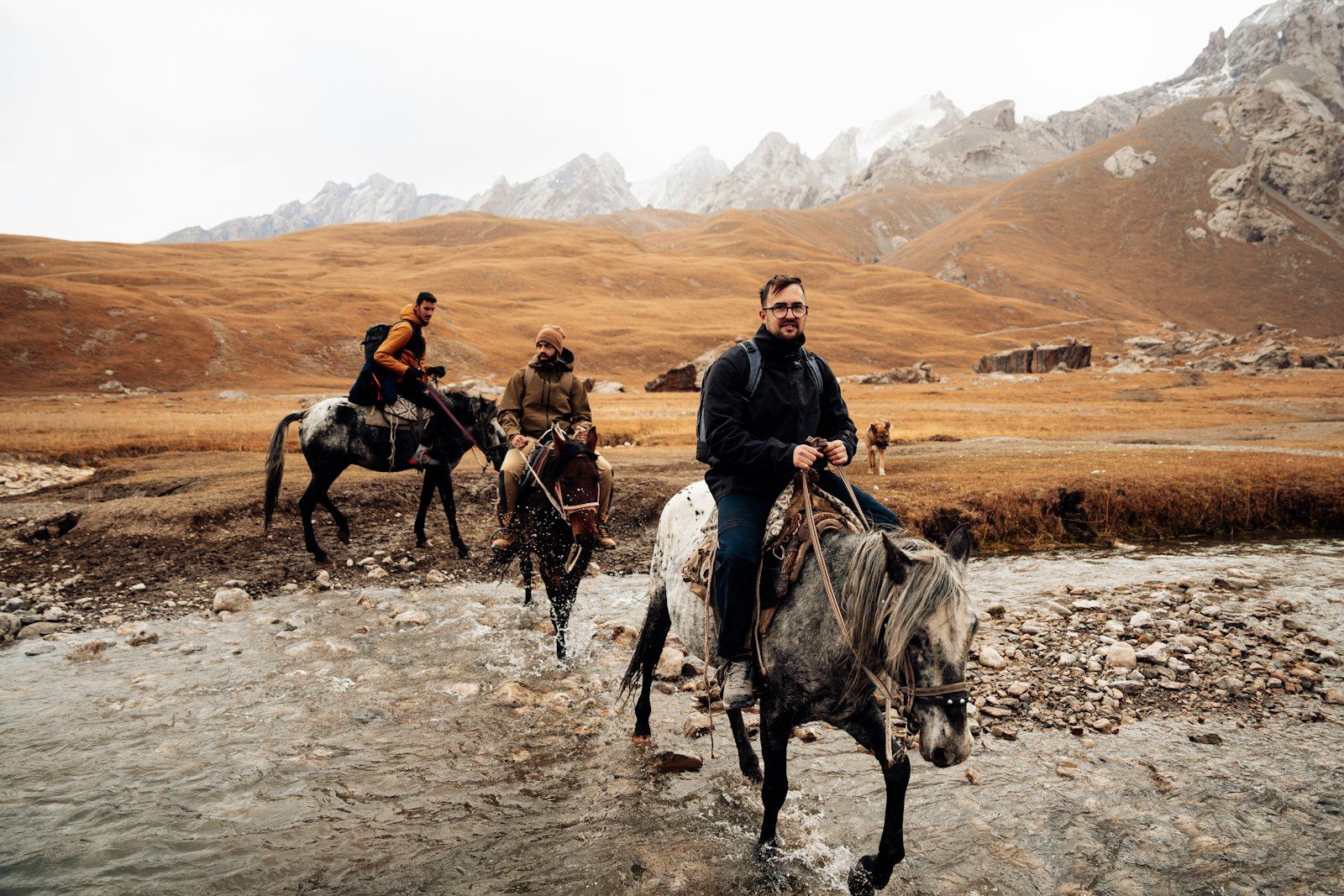
Photo by Spenser Sembrat on Unsplash
- Fitness
- Easy—moderate
- Season
- June—September
- Duration
- 2—5 days
- Region
- Song-Kul, south-shore Issyk-Kul
No riding background required—honesty is.
Beginners can ride when the route, horse and daily hours are chosen carefully. Experienced riders can build a longer traverse.
Good for
- First-time riders willing to learn calmly
- Travelers interested in pasture and yurt life
- Small private groups with different experience levels
Not for
- Anyone expecting fast riding from the first hour
- Travelers uncomfortable with simple rural stays
Start with saddle time, then choose the landscape.
A shorter first ride can be added before committing to a multi-day route.
Song-Kul approach
Open pasture, yurt camps and broad riding country during the accessible summer season.
Issyk-Kul south shore
Village and canyon country with shorter rides and cultural stops.
Introductory ride
A half or full day to learn the horse, basic control and your comfort in the saddle.
What to expect
Riding level
Tell me what you have actually ridden, not only how many years ago.
Daily hours
Saddle time increases gradually and is adjusted for the group.
Horses
Horses are selected for the route and rider; calm handling matters more than speed.
This is the tour closest to my heart. I grew up with these horses and these jailoos — the high summer pastures where Kyrgyz families still take their herds every year — and a horse trek is the one experience I would put above everything else we offer. On horseback you travel at the pace this country was built for, sleeping in shepherd yurt camps a full day from the nearest road. This page covers the treks I run, what they honestly cost, and what they’re honestly like.
Why is horse trekking the signature Kyrgyz experience?
Because for Kyrgyz people the horse is not recreation — it is identity. Horses have been at the center of nomadic life here for some 2,500 years: transport, the muscle that moves a family’s yurt between pastures, milk for kymyz, and the heart of mounted games like kok-boru. We say that horses are the wings of the Kyrgyz people. When you ride up to a jailoo and a shepherd family waves you in for tea, you’re not visiting an attraction — you’re arriving the way guests have always arrived. That is why a horse trek, done properly, beats every “nomadic experience” staged near a highway.
Which horse treks do we run?
What is the Song-Kul crossing?
The classic: three days on horseback from Kyzart village over the high pastures of the Kilemche jailoo to Song-Kul, the shepherd’s lake at 3,016 m. Expect roughly 4–6 hours in the saddle per day and nights in shepherd yurt camps; a 4-day version adds a full day at the lake. One honesty note: published sources describe this route with different pass names and elevations — Chaar-Archa at ~3,061 m on the way in, a 3,300–3,400 m pass down to the lake, and ~3,200 m on the return, under names like Jalgyz-Karagai, Jalgiz Kara, Tuz-Ashuu and Terskey. That’s because different groups take different lines across the jailoo. The day-by-day below reflects the common variants rather than one canonical survey, and we confirm the exact route profile with you when we plan your trek. Season is May/June to September; by October the camps are gone.
Can we ride further — multi-lake and Tash Rabat expeditions?
Yes. For riders with time, there is a multi-day horse connection from Song-Kul south to the Tash Rabat caravanserai — roughly 120 km over about 3 days of high-pass riding. This comes from operator and guide sources rather than a surveyed route, so treat it as medium confidence; we confirm the exact routing and staging against the current season before committing to it. Longer expedition formats exist in the market too — 10-day horseback traverses with loads carried by a horse caravan and nights split between heated tents and shepherd-family yurts — which gives a sense of what a fully custom long ride can look like when we design one together.
What about shorter rides?
Not everyone has three days or wants them. I also arrange day rides and 1–2-day formats — around Jyrgalan, for example, day rides run with a guide and can include a yurt-camp night, with western-style saddles available for riders who prefer them. On Issyk-Kul’s south shore, shorter lakeshore and jailoo rides pair naturally with the eagle hunters and canyons around Bokonbaevo. Tell me how much saddle time you actually want and I’ll build around it.
Do I need riding experience?
No. Most people who ride to Song-Kul are complete beginners, and the trek is built around that: your guide gives a basics lesson at the start, the Kyrgyz mountain horses are steady and sure-footed, and galloping is optional — on flat sections some riders try it, and you should feel completely free to decline. Helmets are provided and worn, full stop. One thing to arrange before you come: travel insurance that explicitly covers horse riding, since some policies exclude it (and may not cover riding without a helmet).
Now the honest part, because “no experience needed” doesn’t mean effortless. You will spend hours a day in the saddle, and on day two you will know it. There are no showers on trek, your clothes will end up dusty and smelling pleasantly of horse, and your small daypack rides in the saddle bags. If you want the full, unvarnished picture — what to wear, what chafes, what surprised past riders — read my beginner’s guide to horse trekking in Kyrgyzstan.
What is included in a guided horse trek?
The standard all-inclusive bundle covers the horse for the trek’s duration, a helmet, your guide, yurt-camp nights and all meals on tour. On agency-format bookings a horseman — usually the horses’ owner — rides alongside the guide. The one thing usually excluded is transport to the start point (for Song-Kul treks, getting to Kyzart); I can arrange that transfer as an add-on.
| Included | Usually excluded |
|---|---|
| Horse for the full trek | Transport to the start point (e.g. Kyzart) |
| Helmet | Travel insurance (must cover horse riding) |
| Guide, plus a horseman on agency formats | Personal snacks and drinks |
| Shepherd yurt-camp nights | Starlink/Wi-Fi where camps sell it separately |
| All meals on tour |
And the yurt-camp reality, so nothing surprises you: shared yurts with mattresses and quilts on the floor, outdoor drop toilets, simple filling meals — bring snacks if you graze between meals. It’s basic, warm and genuine, and for most riders it becomes the part they talk about most.
What does a horse trek cost?
Here is the section most operators skip. I don’t publish a fixed price for my treks, and I won’t print third-party numbers that go stale within a season — instead, let me tell you what actually moves the quote, because that part stays true. Three levers. Group size: six riders share one guide’s day-rate; a private pair carries it alone. Private vs shared: a shared departure costs less than your own guide and horseman. Booking channel: booking village-direct in Kyzart costs less than an agency package — and lets you see the horses’ condition yourself before you commit. My treks sit wherever your choices on those three levers put them. Tell me your dates, group size and route — via the contact page or WhatsApp — and I’ll give you a current figure for the season.
How do we look after the horses?
Fair question, and I’m glad travelers ask it. Tourism demand has led to documented cases of horses being overworked in Kyzart in high season — some animals used on every tour rotation — and travelers are right to check horse condition at the start point and to raise concerns. My commitments: rested horses on rotation, a condition check with you at the start before we ride out, and booking village-direct so the money stays with the families who own and care for the horses. One related caution: on the Ala-Kul trekking route, a widely followed local operator advises against the horse-riding option there over horse-treatment concerns (a single-source opinion, medium confidence) — if we ever discuss horse support on a trekking route, I’ll tell you plainly what I think of the local practice.
When can you ride, and what is it really like up there?
The Song-Kul season runs May to September, with camps fully operating in July and August; shepherds begin descending in mid-September, and by October the camps are gone. There is a concrete end-of-season marker: the Kalmak-Ashuu pass road, the standard vehicle approach, was officially closed to traffic from 6 November 2025 for the winter — dates shift with the snow year, so we recheck annually. For the full month-by-month picture, see when to go.
As for “really like”: Song-Kul sits at 3,016 m, higher than most ski resorts. The July average temperature at the lake is only about +11 °C, nights drop to near freezing even in midsummer once the yurt stove burns out, and snow is possible on the passes even in July. There is little to no phone signal on most of the route — some camps now sell Starlink access separately — and there are no shops and no ATMs. Bring a sleeping bag rated to about −5 °C, full layers, a waterproof shell and serious sun protection. It is cold, quiet and completely worth it.
Sample itinerary — 3 days from Kyzart to Song-Kul
The day-by-day program at the bottom of this page shows the classic three-day crossing: Kyzart to the Kilemche jailoo, over the high pass to the lake, and back over the second pass. It is a sample — pass lines vary by group and conditions, and the final program is tailored on inquiry, including the 4-day version with a full day at the lake.
Planning notes: new to riding? Start with the beginner’s guide. Fitting a trek into a bigger trip is covered in my 7, 10 and 14-day itinerary, and for wider trip budgeting I quote current figures on inquiry.
If a horse trek is the reason you’re coming to Kyrgyzstan — and for many travelers it should be — send me your dates, group size and riding experience through the contact form or WhatsApp, and we’ll design the ride.
Plan this trip — send your dates
I read every inquiry myself and reply with questions, then a draft program.
Thank you — we will reply soon.
You can also say hello on WhatsApp — it's often the fastest way to reach me.