
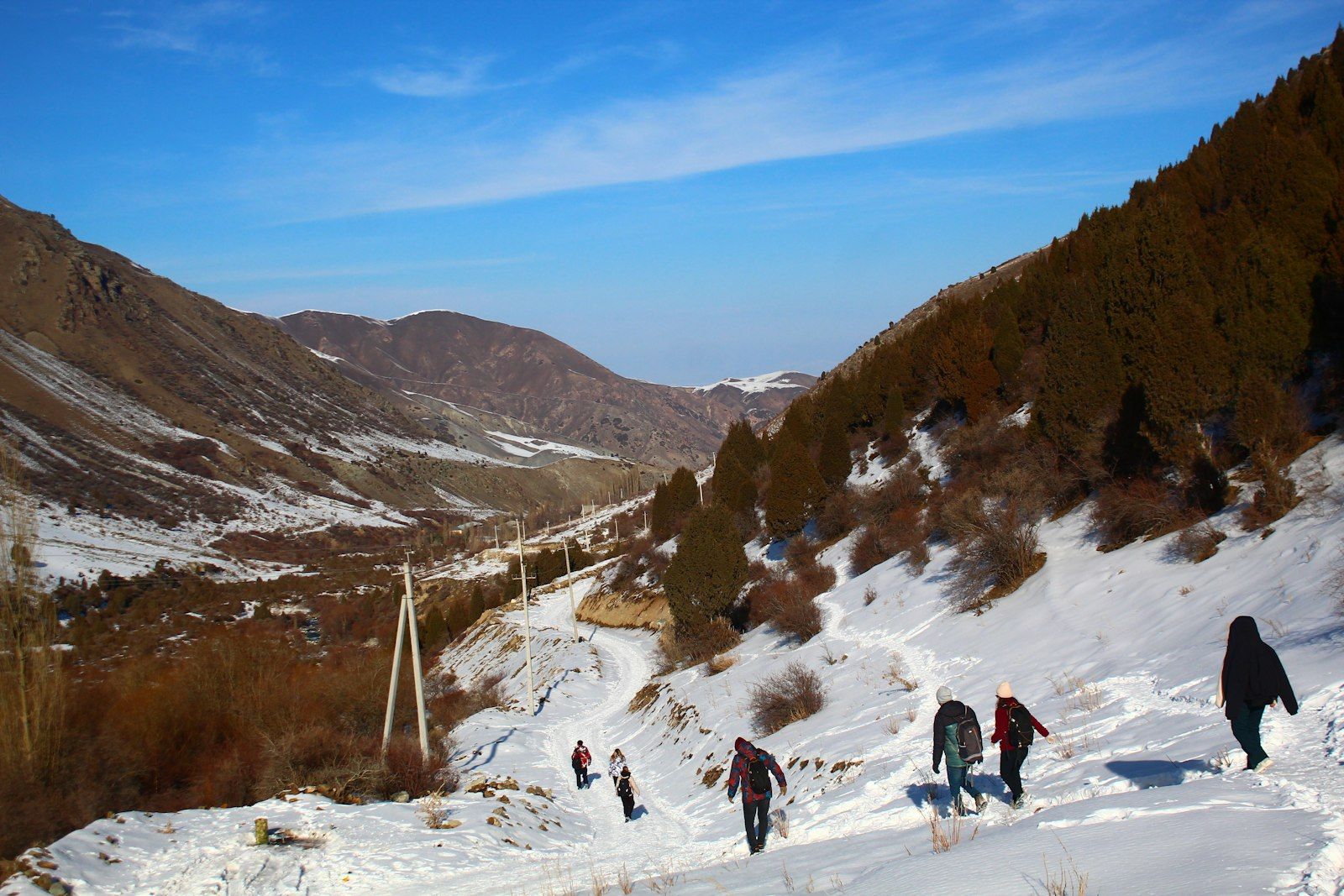
Winter touring
Follow the snow, not a fixed itinerary.
Private ski touring and freeride around Karakol and Jyrgalan, with each day chosen for the group and the conditions we actually find.
Photo by Seval Torun on Unsplash
- Fitness
- Moderate—challenging
- Season
- January—early March
- Duration
- 3—7 days
- Region
- Karakol, Jyrgalan
For capable skiers ready for changing mountain conditions.
Backcountry days require honest skiing ability, suitable equipment and flexibility. The safest useful terrain is the objective—not a promised line.
Good for
- Confident off-piste skiers
- Groups comfortable adapting plans each morning
- Travelers combining ski days with a local valley base
Not for
- First-time skiers
- Anyone requiring a guaranteed peak, face or snow condition
Two winter bases, many daily options.
Weather, stability and visibility decide the terrain each day.
Karakol area
A practical base with access to varied valleys and town services between ski days.
Jyrgalan valley
A quieter community base for lift-free snow and flexible day touring.
Mixed week
Use both bases when road and snow conditions make the transfer worthwhile.
What to expect
Ability
Describe where you ski confidently and your recent touring experience.
Safety
Routes change with snowpack, weather and group movement; flexibility is mandatory.
Equipment
Confirm touring and safety equipment before arrival so gaps can be solved early.
Winter is the season I grew up with on Issyk-Kul’s eastern shore, and it is some of the most honest skiing left anywhere: deep continental powder, empty slopes, and nights in wood-stove yurts. We run guided backcountry ski touring and freeride weeks in the Terskey Ala-Too from two bases — Karakol and the Jyrgalan valley — including multi-day yurt-camp trips. This is a guided product, not a resort guide: for lift maps, pass prices and trail-by-trail data we deliberately point you to the specialist sites in our network instead of duplicating them here.
Many skiers reach this page from exactly those sites — the resort guides on kyrgyzski.com or the storm-cycle notes on powderkyrgyz.com. If that is you, this page is the next step: skiing the lines you have been reading about, with a local guide handling the logistics, the avalanche calls and the yurt camps.
Where do we ski? — Karakol, Jyrgalan, and the yurt camps
Short answer: two bases at the eastern end of Issyk-Kul. Karakol is the anchor — a small ex-Soviet training base whose top chair at 3,040 m opens sidecountry lines through Tien Shan fir forest, with yurt-camp touring in the nearby Ak-Suu valley. Jyrgalan, 60–70 km further east, is a freeride village where snowmobile towing is the standard uplift and yurt lodges run from the village floor to a wilderness camp at 2,900 m.
What is Karakol like in winter?
Karakol is our winter base town, and its ski base — the largest in Kyrgyzstan — works best as a lift-accessed gateway to the sidecountry. Four fixed-grip lifts (8–12 minute rides, short queues outside the New Year holidays) serve about 20 km of groomed pistes from a base at 2,300 m; the top chair reaches 3,040 m, and a snowcat sells rides higher, toward ~3,450 m, when it runs. From the top chair, the lines that matter to us drop through the fir forest — one British ski writer described weekday laps here as feeling like “our own private backcountry resort.” The honest notes: the lifts are aging, the base and mid-mountain cafes are cash-only, and the rental shop runs out on peak days, so rent in town. The base sits inside Karakol National Park, which charges a small entry fee. For the full resort picture — lifts, passes, trails — use the Karakol resort guide on kyrgyzski.com, which keeps that data current season by season.
What is Jyrgalan like in winter?
Jyrgalan is a village at 2,250 m ringed by peaks up to about 3,500 m, positioned by its own destination office as Kyrgyzstan’s premiere freeride destination. The season runs December to April. There are no lifts for now: snowmobile towing to drop-off points is the standard uplift, booked per person with a two-sled minimum and a few days’ advance notice — I confirm the current rates when we plan. The yurt-lodge spectrum is the real draw — from a full-board lodge in the village itself to Jyrgalan Heights at 2,900 m, 11 km above the village in what the operator calls complete wilderness. One piece of dated news worth knowing: the Ala-Too mega-resort is under construction at Jyrgalan Pass, billed as the largest in Central Asia, with first slopes slated for the end of 2026 (ski trade press, January 2026). That timeline is fast-moving — re-verify it before you plan around it, and expect the valley to change as it lands.
What is yurt-based ski touring?
It is the signature Kyrgyz winter experience: a camp of felt yurts heated by wood stoves, full board, a sauna tent, and a snowmobile that carries the luggage so you tour light, straight from the camp door. The established example near Karakol is the Ak-Suu camp at about 2,590 m, with touring terrain rising toward 4,000 m; Jyrgalan has its own camps in and above the village. Rates at the camps are set seasonally — I reconfirm them with the operators before every trip I quote.
When is the best time for ski touring in Kyrgyzstan?
The touring season runs from mid-November to early April, and the top powder window is January to March. Karakol’s lifts are at their best in January–February, Jyrgalan skis from December to April, and the snow — thanks to the dry cold and low wind — stays soft for weeks after a storm instead of turning to crust. For perishable, dated condition snapshots and storm-cycle notes, check powderkyrgyz.com before you fix dates; for the all-activity picture, see our when to go matrix.
| Months | What to expect |
|---|---|
| Mid–late November | Season opens; Karakol’s lifts typically start late in the month. Thin early base, very quiet. |
| December | Jyrgalan’s season begins; storms build the pack. Short, cold days. |
| January–February | Top powder window and Karakol’s best months — and the coldest weeks, with −20 °C days. |
| March | Still deep; longer days and slightly kinder temperatures. Watch for rapid warming after storms. |
| Early April | The tail of the touring season; a hard crust develops on lower slopes by late April. |
Is ski touring in Kyrgyzstan safe? Do I need a guide?
Honest answer: the terrain beyond the marked pistes is uncontrolled, and the Tien Shan snowpack is shallow, continental and facet-driven — persistent weak layers are the norm here, not the exception. A Snow Magazine writer touring with an experienced group near Karakol heard the pack “whoomph” under them and triggered a small avalanche. Kyrgyzstan does have a public avalanche bulletin — snowreport.kg publishes danger ratings and recent activity for the ski bases through the season — and the standard safety model is guided touring with beacon, shovel and probe, on days checked against the bulletin. When the danger rating is high, guided groups drop to conservative, lower-angle tree laps. That is not an upsell; it is how this snowpack is skied.
What is the snow like?
Ski media call it “cold smoke.” Fieldmag’s January 2026 account describes snow “made entirely of facets, sugar-like snow flakes” that skis “more like waterskiing than resort skiing” — bottomless, and slow to consolidate. The gear implication is real: bring skis of 115 mm or more underfoot and a full avalanche kit; specialist guides recommend an airbag pack on top. Ski media also credit the never-freezing Issyk-Kul with feeding lake-effect storms into the Terskey Ala-Too above Karakol — a plausible mechanism we repeat as their framing, not confirmed meteorology.
What safety standards do we follow?
Every guest skis with a beacon, shovel and probe, and every ski day starts with the bulletin and a conservative terrain call. Who leads your ski days — Kylych personally or a certified partner — is something we confirm with you directly when you inquire; we do not claim credentials that are not confirmed.
What does a guided winter trip cost?
We quote winter rates on inquiry, tailored to the season and your group — I don’t publish fixed figures, because this market reprices every season and a stale number helps no one. What drives the quote: your dates (the New Year period carries surcharges almost everywhere), your group size, the split between lift-served and guided backcountry days, and the level of the camps and lodges we book. For the wider budget picture — transport, food, accommodation — ask when you inquire and I’ll share the current figures.
How do we get there in winter?
By road, almost always. Bishkek to Karakol is about 400 km — six to seven hours along Issyk-Kul’s north shore on a mostly smooth two-lane highway. A private taxi is the comfortable option — ask me for the current going rate when you inquire; the marshrutka from the Western Bus Station is far cheaper but awkward with ski bags. Karakol Airport sees only occasional seasonal flights, so plan on the drive. From town, the last 13 km to the ski base climbs a mountain road where a 4×4 is strongly recommended; a round-trip taxi from town is the usual way up. The real limiting factor is cold: expect −20 °C days in mid-winter and pack expedition-grade layers. And bring cash — the base does not take cards.
What does a sample week look like?
Seven days is the natural shape: three ski days around Karakol and the Ak-Suu yurt camp, then a transfer east for two freeride days in Jyrgalan, with road days at each end. The day-by-day below is a sample itinerary — the final program is tailored on inquiry, around the season, the snowpack and your group. If you want winter-culture experiences around the ski days — for example the south-shore eagle hunters or the hot springs — ask when you inquire and we will tell you honestly what we can arrange.
How does Kyrgyzstan compare to Georgia or Japan?
Our editorial take, not a statistic: Kyrgyzstan sits one adoption cycle earlier than Gudauri or Japan. Georgia is the established ex-Soviet freeride circuit, with modern lifts and heavy Russian and European traffic; Japan has absorbed a decade of powder pilgrims. Kyrgyzstan offers fewer lifts, emptier slopes and far lower prices, in exchange for higher adventure overhead — fixed-grip chairs, snowmobile tows, cash-only bases. Ski media frames it as the next frontier after the Japan boom; one January 2026 account counted roughly 40 western travelers over nine weeks at a single operation, and a cat-ski day in Jyrgalan has been reported at a fraction of the going rate in established destinations (a single social post — treat as indicative). Add visa-free entry (30 days within 60 for most Western passports, 90 for EAEU), and the value case is strong. What you trade away is convenience, and this page has tried not to hide that.
Planning your winter trip
- When to go — the all-activity season matrix, including the January–early March ski window.
- Kyrgyzstan itineraries for 7, 10 and 14 days — including how a winter variant fits together.
- Ready to talk dates? Contact us and we will shape a week around the season.
Plan this trip — send your dates
I read every inquiry myself and reply with questions, then a draft program.
Thank you — we will reply soon.
You can also say hello on WhatsApp — it's often the fastest way to reach me.