Destinations
Lenin Peak & Alay, with enough time to understand the place.
Yurt camps and glacier views beneath a 7,134 m peak.
- Season
- June—September
- Base
- Sary-Mogol / Osh
- Pace
- 2—4 days
Go for the place—not only the landmark.
The strongest visit leaves room for local conditions, short walks and the road itself.
- Use one practical base instead of changing hotels every night.
- Match outdoor plans to the season before fixing transfers.
- Leave margin for mountain roads, weather and unplanned stops.
Build a route that still feels like a journey.
Pair nearby places before adding another distant region.
Tash Rabat
A sensible companion when dates and road conditions allow.
Song-Kul
A sensible companion when dates and road conditions allow.
Sary-Chelek
A sensible companion when dates and road conditions allow.
What to decide before you go
Access
Mountain roads take longer than the map suggests; confirm the current approach.
Stay
Choose the base around the next day's activity, not only the best-known town.
Conditions
Weather, road work and seasonal camps can change the final plan.
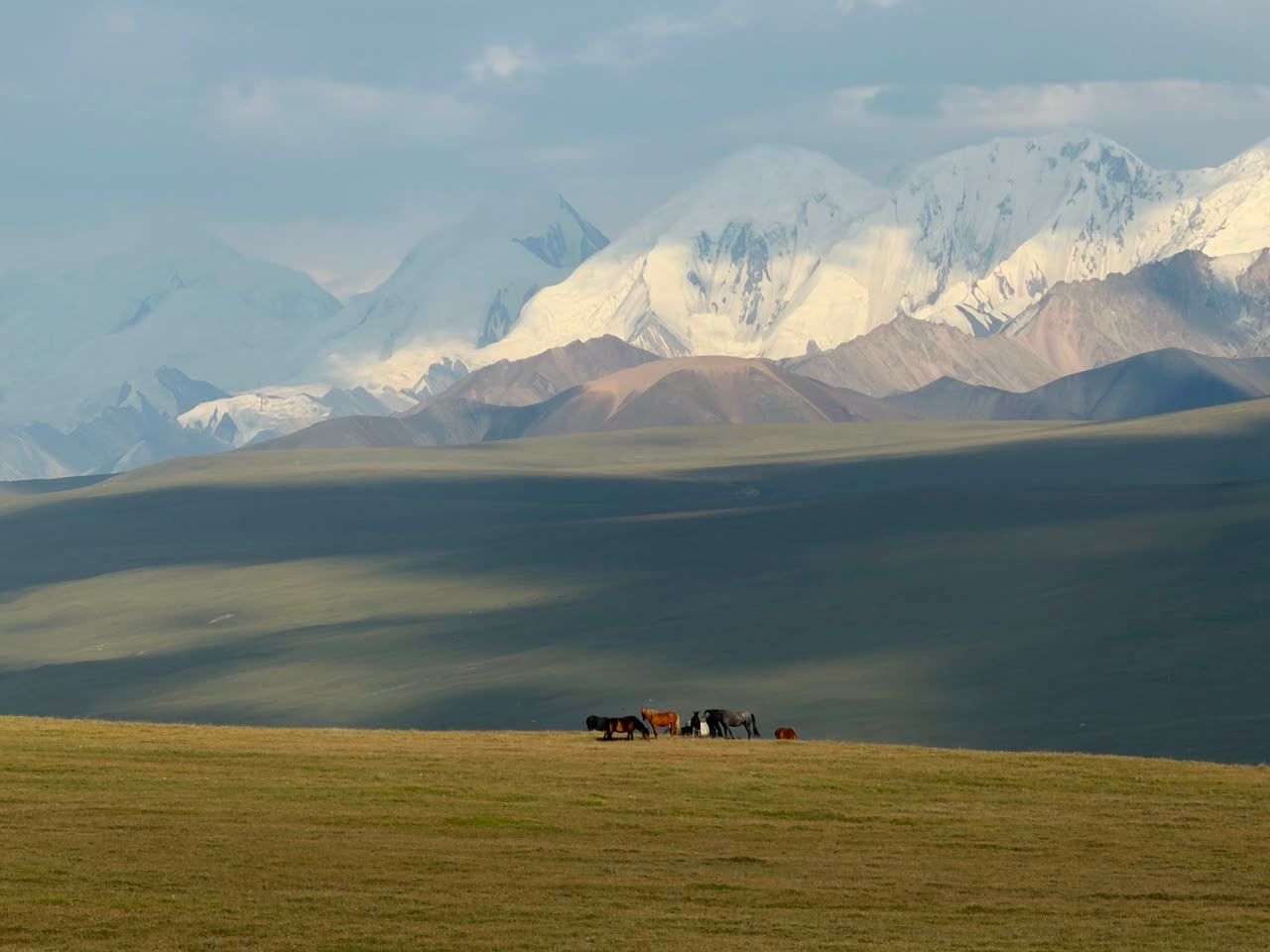
Lenin Peak rises 7,134 m over the Alay Valley in the far south of Kyrgyzstan — the second-highest mountain in the country and the highest point of the Trans-Alay Range, right on the Kyrgyz–Tajik border. You do not need to be a mountaineer to stand beneath it. The Achik-Tash base camp and the yurt camps at Tulpar-Köl lake sit on open alpine ground, reachable on foot or by 4x4 from Osh, and the best views of the peak come from walking trails, not climbing ropes. You will read elsewhere that Lenin Peak is the “easiest 7,000-er in the world” — take that honestly: the mountain is technically moderate by 7,000 m standards, but altitude is a real hazard even on the approach, and this page treats it that way.
Where exactly are Lenin Peak base camp and Tulpar-Köl?
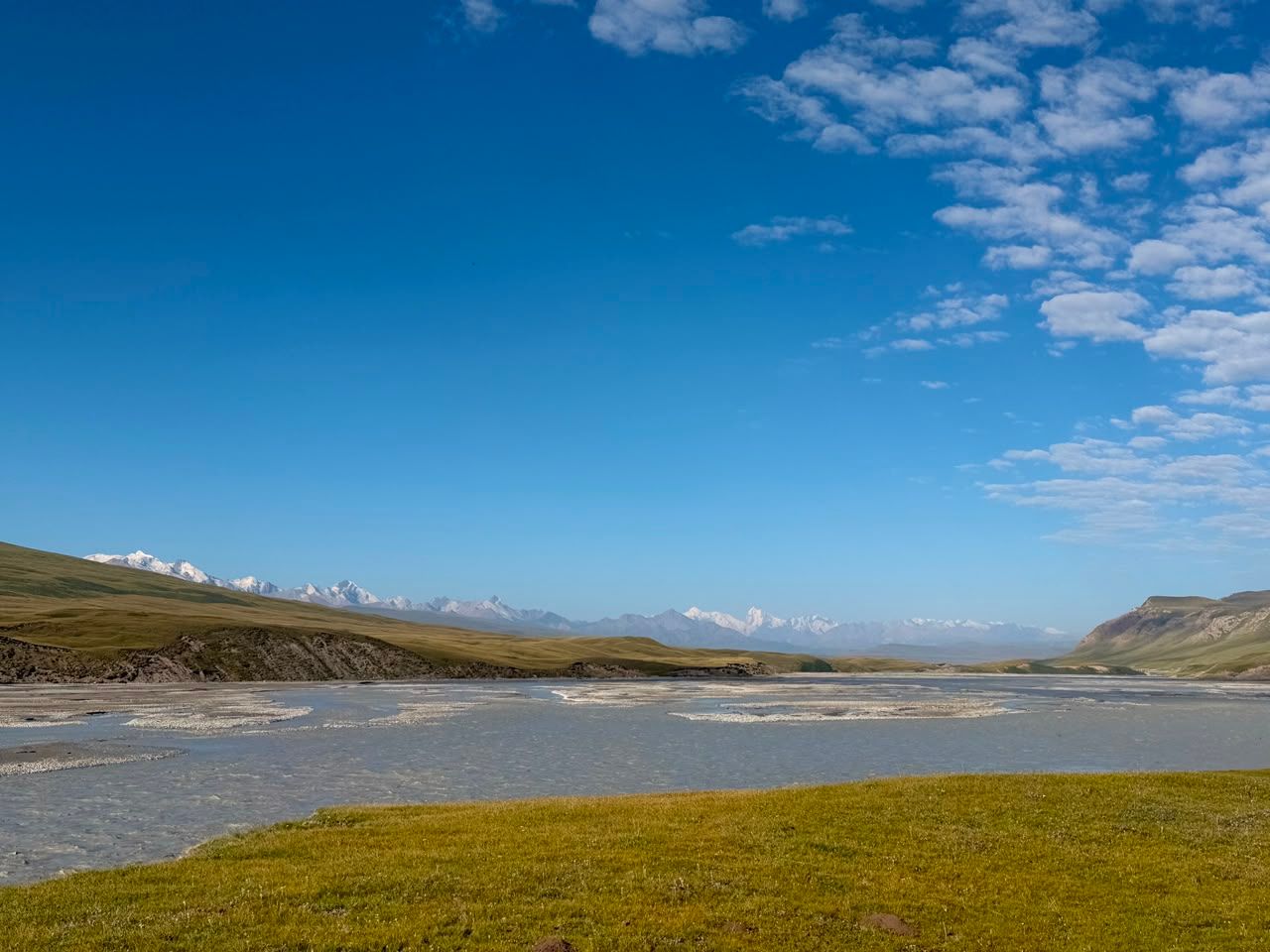
Achik-Tash base camp sits at roughly 3,600 m on the Achik-Tash river, on the northern side of the Trans-Alay. An international mountaineering camp was established here in 1972, and the meadow it stands on is known for its edelweiss. A short walk across a bridge from the base camp lies Tulpar-Köl, a cluster of small alpine lakes at about 3,500 m, ringed by yurt camps in summer. Both are reached through Sary-Mogol village (around 3,000–3,200 m) in the Alay Valley of Osh region. One naming note: on the Tajik side the mountain has been called Ibn Sina Peak since 2006 — same mountain, different map.
What is the Alay Valley like?
The Alay Valley is a broad, high valley — roughly 2,200 to 3,500 m — running east–west between the Alay Range to the north and the snow-covered Trans-Alay wall to the south, with Lenin Peak dominating that wall. In summer the valley floor is jailoo: green pasture with grazing horses and the yurts of herding families. Mornings are usually clear; cloud builds around the peaks toward midday, so the big views belong to early risers. Warm clothing is essential at any time of year — this is high country even where the road is good.
What can non-climbers do at Lenin Peak base camp?
More than most visitors expect: viewpoint day hikes, an easy panorama walk around the lakes, nights in a yurt camp under a 7,000 m skyline, and — for stronger trekkers — a 5,000 m summit that requires no climbing gear at all. None of the options below involve glacier travel. I guide in this area myself, and for fit travellers who will never touch a rope, this is one of the most rewarding corners of the country.
| Hike | Elevation | Effort | Time | Who it suits |
|---|---|---|---|---|
| Tulpar-Köl panorama walk | ~3,900 m high point | Easy | Half day (~12 km round trip, ~485 m gain) | Anyone reasonably fit |
| Traveller’s Pass | 4,100 m | Moderate | ~3 h up / 2 h down | Fit walkers, the classic viewpoint |
| Petrovsky Peak ridge | ~4,150 m | Moderate | 3–4 h | Acclimatization hike, big views |
| Yukhina Peak | 5,130 m | Strenuous | 2–3 days via Camp 1 | Strong trekkers, no gear needed |
Traveller’s Pass (4,100 m)
This is the classic Lenin Peak viewpoint hike, and the one I recommend first. From the base camp or the Tulpar-Köl yurt camps it is roughly three hours up and two hours down on a clear trail. At the pass you stand directly above the Lenin Glacier with the whole north face of the peak in front of you — without stepping onto the glacier itself. Go early: the cloud that builds around midday often closes the view by afternoon.
Tulpar-Köl panorama walk
For an easier day, the panorama walk around the Tulpar-Köl lakes covers about 12 km round trip with roughly 485 m of climbing — a gentle half-day from the yurt camps. The trail stays on open pasture and moraine, and the lakes in the foreground of the Trans-Alay wall make this the best low-effort option for travellers who want the 7,000 m photo without the 4,000 m pass.
Petrovsky Peak ridge and Yukhina Peak (5,130 m)
Think of the local hikes as a ladder. One rung above Traveller’s Pass is the Petrovsky Peak ridge viewpoint at about 4,150 m — a three-to-four-hour outing that doubles as an acclimatization hike. The top rung for non-climbers is Yukhina Peak at 5,130 m: a genuine 5,000 m summit, reached over two to three days via Camp 1, with no climbing gear required. Two honest cautions: the Camp 1 area can hold snow and ice even in mid-August, and beyond Yukhina the ladder stops for non-climbers — Razdelnaya (6,148 m) requires full glacier equipment and is out of scope here.
Horse & Yak Games at Tulpar-Köl
On the third weekend of July, CBT Sary-Mogol runs the annual Horse & Yak Games at Tulpar-Köl — kok-boru (horseback goat polo), yak wrestling, crafts and food, staged in front of the peak. If your dates are flexible, it is a memorable weekend to be in the valley. Dates shift slightly year to year, so confirm the exact weekend before planning around it.
How do I get there from Osh?
Osh is the gateway. From there a fully paved road runs south to Sary-Mogol — about three hours by shared taxi or roughly four hours on the daily marshrutka, both charging per seat; check the current fare at the station before you travel. From Sary-Mogol, a 25 km dirt road climbs to the Tulpar-Köl yurt camps: about 45 minutes by hired 4x4 (booked per car through CBT Sary-Mogol — ask them, or me, for the current rate), eight to nine hours on foot, or four to five hours by horse. Achik-Tash base camp itself is either a further rough 4x4 leg — add an hour and a half to two hours from Sary-Mogol — or a short walk from Tulpar-Köl across the bridge.
What about Sary-Mogol village itself?
Sary-Mogol is a village of about 5,000 people on a plateau at around 3,000–3,200 m, and it is the jump-off point for every trek in the Alay. There are homestays — several with a banya, welcome after cold nights at the lakes — and the community includes Wakhan Kyrgyz families resettled from the Afghan Pamir. For multi-day trekkers, the village anchors the region’s signature non-technical route: the five-day “Heights of Alay” loop over Sary-Mogol Pass (~4,300 m) and Jiptik Pass (4,185 m), passing the red-rock village of Kojo-Kelen. I run guided treks in this region — tell me what you are after and we build from there.
When is the best season to visit Achik-Tash and Tulpar-Köl?
The camp season runs roughly June to September, with July and August the prime months. Late spring and early autumn are feasible for Tulpar-Köl and the base camp area only, with a real chance of wind and snow. In mid-summer, days at base camp run 10–20 °C and nights drop close to 0 °C — expect near-freezing every night at Tulpar-Köl even in August. In winter the area falls to −30 °C and is effectively inaccessible. For how this lines up with the rest of the country, see the month-by-month season matrix.
Do I need to worry about altitude?
Yes — take it seriously, even as a hiker. Sary-Mogol is already at about 3,000 m and the base camp at 3,600 m, so you sleep high from the first night. My practical advice: spend your first night in Sary-Mogol rather than driving straight to the lakes, walk slowly on day one, and save Traveller’s Pass for your second or third day. If you feel unwell at altitude, the answer is to descend, not to push on. The mountains will still be there tomorrow.
Do I need a border-zone permit for Lenin Peak base camp?
Officially, yes. The base camp area lies close to the Tajik border, inside a zone where Kyrgyzstan requires a Border Zone Permit. The permit carries a processing fee and takes one to two weeks to arrange — some sources say 10 to 20 days — and it is applied for through a local tour company using a copy of your passport; I confirm the current fee when I arrange it for you. In practice, enforcement is inconsistent and many travellers are never checked, but border guards can ask, and the rules change from season to season. My position is simple: the permit is officially required, so we arrange it. Note that this is separate from entry rules — the border-zone permit applies regardless of your nationality or visa status.
How do I get the permit arranged?
Send me a scan or photo of your passport and your travel dates, and I arrange the permit through the local system — along with the 4x4 from Sary-Mogol and your yurt camp beds. The one thing I ask is lead time: message me at least a few weeks before you travel so the paperwork is never the thing that holds up your trip.
Where do you stay — yurt camps or base camp tents?
At Tulpar-Köl, community-run (CBT) and private yurt camps offer beds per night including breakfast and dinner — rates change each season, so I don’t quote figures here; ask me and I’ll confirm the current ones for your dates — and you can pitch your own tent free in designated areas. At Achik-Tash, several full-service yurt and tent camps cater to climbing expeditions, priced above the local alternatives. Down in Sary-Mogol, homestays with hot meals and a banya make a comfortable first or last night. Most visitors do best with a night in Sary-Mogol followed by two or three nights at Tulpar-Köl — enough time to acclimatize and walk the main viewpoints without rushing.
Can I combine Lenin Peak with the rest of Kyrgyzstan?
Easily, and it pairs well. The natural route is a south-Kyrgyzstan loop through Osh: the Alay Valley’s stark high plateau against, say, Sary-Chelek’s forested lakes in the western Tien Shan gives you two completely different Kyrgyzstans in one trip. Overlanders on the Pamir Highway pass through this valley as a matter of course, and for travellers planning a wider trip, my notes on route logic for 7–14 days show how the Alay fits alongside Issyk-Kul and the central ranges. If pasture life and village stays are what draw you, the valley also features in my eco and nature tours.
Planning a trip to Lenin Peak?
Osh pickup, the 4x4 to Tulpar-Köl, yurt camp beds, the border-zone permit, and a guide on the trails — one message covers all of it. Tell me your dates and group size through the contact form or on WhatsApp, and I will put together a program that matches how you like to travel. (Sample programs are tailored on inquiry — nothing here is a fixed package, and summit expeditions are outside what I offer.)
Message us on WhatsApp (opens in new tab)
Contact
Want to see this place with someone who knows the road in? Message Kylych on WhatsApp with your dates and group size, or send the inquiry form — you will hear back with an honest plan, not a package pitch.