Silk Road culture
Meet living traditions, not a staged checklist.
A private cultural route through caravan history, village life, crafts and the communities around Issyk-Kul and Naryn.
Photo by Seval Torun on Unsplash
- Fitness
- Easy
- Season
- May—June, September—October
- Duration
- 4—8 days
- Region
- Naryn, Issyk-Kul south shore
Travel through context and conversation.
The route leaves time for people and place. Cultural journeys can run year-round, while the shoulder seasons are especially comfortable for overland travel.
Good for
- Travelers interested in history and present-day life
- Mixed-ability groups
- A first trip combining culture with light nature
Not for
- A trip built only around fast photo stops
- A high-altitude trekking objective
Build a cultural line across the country.
The strongest route connects fewer places with enough time in each.
Burana & Chüy valley
Silk Road history close to Bishkek and a useful opening to the journey.
Tash Rabat & Naryn
A stone caravanserai in a high valley, reached through central mountain country.
Issyk-Kul south shore
Villages, yurt stays, craft traditions and responsible eagle-hunter visits.
What to expect
Visits
Timing depends on the people and places involved, not an hourly attraction schedule.
Stays
Use locally run guesthouses and yurt camps where they fit the route.
Respect
Ask before photographing people and approach traditions as living culture.
Kyrgyzstan’s Silk Road story is not locked in museums. The caravanserai still stands at 3,200 meters, the minaret still rises over the Chuy Valley, and the culture the caravans fed — felt, falconry, yurt craft, Dungan cooking — is still practiced by families I know.
What does a cultural and Silk Road tour with Kylych actually include?
A private, modular circuit combining heritage sites — Burana Tower, Tash Rabat, optionally Uzgen and Osh — with living culture: felt workshops, yurt-building demonstrations, an eagle-hunter demonstration on Issyk-Kul’s south shore, and dinner at family tables rather than hotel buffets. You sleep in village homestays and seasonal yurt camps, and we time the days around what is worth timing, from a Sunday animal market to a demonstration in good evening light. Every program is tailored on inquiry; what follows are the building blocks, not a package.
Which Silk Road sites do we visit?
What is Tash Rabat?
Tash Rabat is a 15th-century stone caravanserai in Naryn Region’s At-Bashy district, at roughly 3,200 meters and about two hours south of Naryn city, directly on the old caravan route toward the Torugart Pass and Kashgar. One hypothesis, dating to a Russian traveler in 1888, holds that it began as a Nestorian or Buddhist monastery — an open scholarly question, and I present it that way.
There is no public transport; we drive. Yurt camps operate beside the caravanserai in season, and the overnight is the version I recommend — you sleep where the caravans slept. More in the Tash Rabat caravanserai guide, plus deeper Silk Road history on our sister site.
What is Burana Tower?
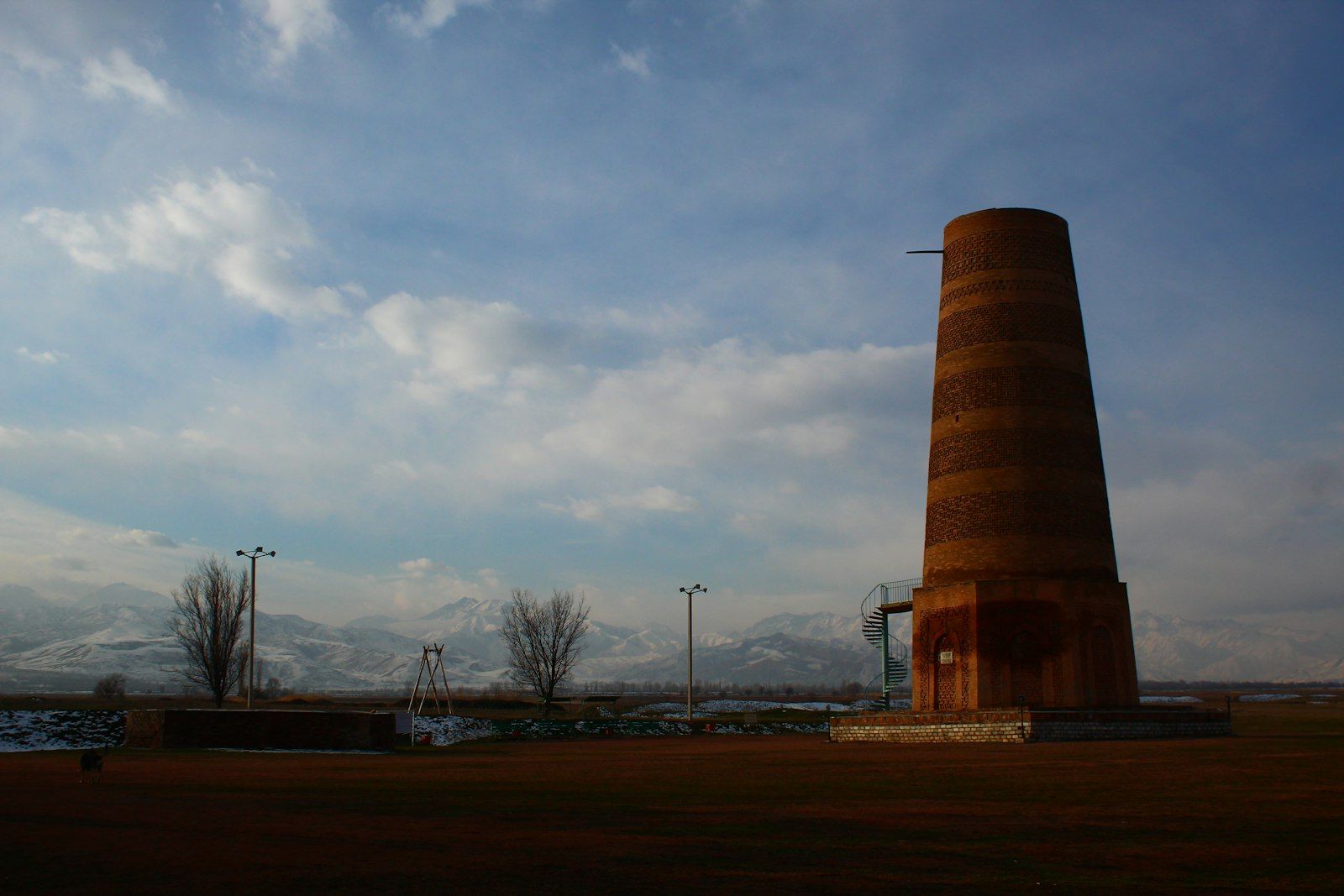
Burana Tower is an 11th-century minaret on the site of Balasagun, capital of the Karakhanid Khanate, near Tokmok about 80 km east of Bishkek. It originally rose about 45 meters; earthquakes reduced it to roughly 25. A field of balbals — Turkic stone grave markers — surrounds it, and you can climb the narrow spiral staircase for the view over the Chuy Valley. Balasagun is one of three Kyrgyz components of the UNESCO “Silk Roads: the Routes Network of Chang’an–Tianshan Corridor” listing, inscribed in 2014. It sits directly on the road east toward Issyk-Kul, the natural day-one stop. Entry fees change often, so I confirm current prices before each trip rather than print a number.
Can we extend south to Osh and Uzgen?
Yes — on trips of ten days or more we continue overland to Osh, adding the Fergana Valley layer to the mountain-nomad one. En route we stop at Uzgen, a Karakhanid capital where an 11th-century minaret and three mausoleums survive in baked brick. In Osh, Sulaiman-Too — a mountain venerated for at least 1,500 years — became Kyrgyzstan’s first UNESCO World Heritage site in 2009; below it, the Jayma Bazaar runs about a kilometer, busiest on Sunday mornings. Two UNESCO listings, one trip. One caveat: a World Bank–financed reconstruction of the Sulaiman-Too complex began in 2025, so expect some access changes — I check conditions before every south-bound departure.
Where do you see eagle hunting — and is it a real hunt?
You see it in Bokonbaevo on Issyk-Kul’s south shore — and no, what you watch in summer is not a real hunt, and I will always tell you that plainly. Bokonbaevo is the country’s eagle-hunting center: per the local community-tourism coordinator, of roughly 30 working bürkütchü left in Kyrgyzstan, about 15 are based there. Warm-weather guests see a demonstration — the eagle flies to a lure, no live prey is taken — but it is given by working hunters with the same birds they hunt in winter. Real hunts happen late autumn through winter, roughly October to February. Come in winter and we arrange one on horseback; come in summer for a genuine window into a living tradition. Full story and ethics: The Bürkütchü of Issyk-Kul’s South Shore. The area: Bokonbaevo and the south shore.
What happens at a demonstration?
One to two hours, following a recognizable arc: an unhurried introduction to the bird, then she is carried to a rise and released on signal, first to a static lure, then to a moving target dragged behind a galloping horse. Most demonstrations include taigan dogs — the Kyrgyz sighthound — and traditional archery you can try; the whole complex of horse, eagle, taigan and bow is called salbuurun. At the end, gloved and coached, you hold the eagle for the photograph. These birds can weigh over nine kilograms — harder than it looks.
Is eagle hunting ethical?
Asked properly, and answered properly. Falconry is on UNESCO’s intangible-heritage list, with Kyrgyzstan added in 2021, and it remains a working tradition — many bürkütchü still hunt in winter, and demonstration income helps keep the practice alive. The markers of a good operation are birds flown regularly, unhurried handling, a hunter who puts the bird’s condition before the show, and an eventual release to the wild. Tradition holds that after years of partnership a hunting eagle is released to breed; accounts differ on exactly when, and I’d rather you hear that answer from the hunter himself. The red flags: chained birds, rushed performances, anyone offering a forced out-of-season “hunt” in summer heat. I book through Bokonbaevo’s community-tourism office and the Salburun Federation, which exist to keep the tradition responsible.
This is also how booking works here: a WhatsApp message a day or two ahead. Know your south-shore dates? Message me now — the button sits at the bottom of every page — and I’ll confirm hunter, light and timing before you arrive.
What living culture do you take part in — not just watch?
Who builds the yurts?
Kyzyl-Tuu, a village near Bokonbaevo, is the recognized center of yurt-frame craftsmanship — the whole village builds yurts, and the skill passes through its families. At a demonstration, two or three experienced builders raise the frame in about two hours: the kerege lattice walls expand, the curved uuk roof poles slot into the tündük, the wooden crown at the top. That tündük is the symbol at the center of Kyrgyzstan’s flag, inside a sun of 40 rays for the 40 tribes. The craft is UNESCO-listed: traditional Kyrgyz and Kazakh yurt-making was inscribed as intangible cultural heritage in 2014. Our sister site has more on yurt construction and heritage.
What happens at a Kochkor felt workshop?
Kochkor, three hours from Bishkek on the road toward Song-Kul, is the country’s shyrdak (felt carpet) center, and its women’s collectives run hands-on workshops. You see the whole wet-felting process: washed wool laid in layers on a reed mat, doused with hot soapy water, then rolled and kneaded until the fibers lock. Patterns are drawn in chalk, cut through two contrasting layers at once, and recombined so each carpet carries the jigsaw negative of its twin. The craft sits on UNESCO’s List of Intangible Cultural Heritage in Need of Urgent Safeguarding, inscribed in 2012 — the masters are aging, and ala-kiyiz, the sister technique, has nearly disappeared from homes. When you sit down at a workshop, your visit is part of why the craft survives.
Where do the Dungans of Karakol fit in?
Karakol’s Dungan community descends from Chinese Muslims who fled a failed revolt and crossed the snow-covered Tien Shan in the winter of 1877–78; one group of around 1,130 people from Gansu was settled at Yrdyk, just outside Karakol, in spring 1878. Their cooking has defined the town’s table since. The signature dish is ashlyan-fu, a cold, spicy noodle soup with vinegar, chili and garlic, eaten with a fried piroshki — the small Bugu Bazaar devotes a whole “Ashlyan-fu Alley” to it. Better still is dinner in a Dungan family home, arranged through families I know. Time Karakol for a Sunday morning and we start at the animal market outside town — sheep, horses and cattle traded from first light. Set an alarm. More in the Karakol guide.
Who are the families you stay with?
Real hosts, in the community-tourism tradition this country pioneered. Kyrgyzstan’s Community Based Tourism association was registered in 2003, growing out of a Swiss-supported program helping rural women start tourism businesses; today it federates around 15 local groups and more than 400 host families, and the point of the model is that tourism income stays in the village. It is the network I work in: you eat at your hosts’ table, sleep in their guest room or their yurt. I keep their names off the website at their request, but you will know them within a day of arriving. The bus-tour version of this country sells a standard culture menu — a folklore show, a craft shop, a photo stop. We eat dinner instead.
What about the World Nomad Games 2026?
The World Nomad Games return to Kyrgyzstan from 31 August to 6 September 2026 — the sixth edition of the event the country founded in 2014. Salbuurun is a core discipline, and past editions featured a yurt village of hundreds of yurts in Kyrchyn Gorge. It is the one moment when everything on this page happens at once, at world scale. What I offer around the games is practical: private transport, south-shore side trips between event days, and personal introductions to bürkütchü families — not ticket packages. Dates are confirmed; as of late July 2026 the venue and program details were still being announced, so check the World Nomad Games 2026 guide for the current picture.
How many days do you need?
Five to seven days covers the core Bishkek loop comfortably; ten to fourteen adds the overland south to Osh.
| Duration | Route | What it covers |
|---|---|---|
| 5–7 days | Bishkek → Burana → Kochkor → Song-Kul or Tash Rabat → south shore → Karakol → Bishkek | Both anchor sites, felt workshop, yurt-camp nights (in season), eagle demonstration, Kyzyl-Tuu, Dungan Karakol |
| 10–14 days | The loop, plus Bishkek–Osh overland one way | All of the above, plus Uzgen, Sulaiman-Too, Jayma Bazaar, the Suusamyr valley and Toktogul reservoir |
Sample itinerary — final program tailored on inquiry. The Song-Kul guide covers the yurt-camp nights, including the honest season cut-off.
When is the best season for a cultural tour?
Different parts of the tour have different seasons — which is exactly why the program is modular:
| Season | What’s on |
|---|---|
| Year-round | Burana and the Chuy Valley sites, Karakol town and Dungan dinners, felt workshops, homestays |
| May–October (core window) | The full circuit at its easiest: all roads open, workshops and demonstrations running |
| June–September only | Jailoo yurt camps and herder life, Song-Kul, Tash Rabat access |
| Late autumn–winter | Real eagle hunts on horseback, not demonstrations |
September deserves a mention: crowds thin, markets fill with harvest, herders descend from the high pastures. The full month-by-month breakdown lives on When to Go.
How is this different from a bus tour?
Timing, tables, and honesty. A fixed bus schedule cannot chase a Sunday-morning animal market, a demonstration in golden evening light, or a climb of Sulaiman-Too before the southern heat — I plan around exactly those clocks. You eat at family tables instead of museum car parks, in villages where your money stays. And you get candor about what is staged: which experiences are demonstrations, which seasons are real, which stories historians still argue over.
How do you book, and what does it cost?
There is no fixed published price, because there is no fixed tour: each program is quoted on inquiry, based on dates, group size and route. For honest context, I lay out what things actually cost on the ground when you inquire. For the eagle demonstration itself, the hunters set their fee seasonally and it varies with group size and transport — I confirm the current figure with Bokonbaevo’s community-tourism office when we book. What I promise is this: I tell you exactly what your trip costs before you commit to anything.
Tell me your dates and group size through the form below, or message me on WhatsApp — the button is at the bottom of every page — and I’ll come back with a proposed route and a straight price. You can also reach me via the contact page.
Plan this trip — send your dates
I read every inquiry myself and reply with questions, then a draft program.
Thank you — we will reply soon.
You can also say hello on WhatsApp — it's often the fastest way to reach me.