
Destinations
Bokonbaevo & south shore, with enough time to understand the place.
Eagle hunters, red-rock canyons and quiet lake camps.
- Season
- May—September; culture year-round
- Base
- Bokonbaevo
- Pace
- 2—4 days
Go for the place—not only the landmark.
The strongest visit leaves room for local conditions, short walks and the road itself.
- Use one practical base instead of changing hotels every night.
- Match outdoor plans to the season before fixing transfers.
- Leave margin for mountain roads, weather and unplanned stops.
Build a route that still feels like a journey.
Pair nearby places before adding another distant region.
Issyk-Kul
A sensible companion when dates and road conditions allow.
Song-Kul
A sensible companion when dates and road conditions allow.
Tash Rabat
A sensible companion when dates and road conditions allow.
What to decide before you go
Access
Mountain roads take longer than the map suggests; confirm the current approach.
Stay
Choose the base around the next day's activity, not only the best-known town.
Conditions
Weather, road work and seasonal camps can change the final plan.
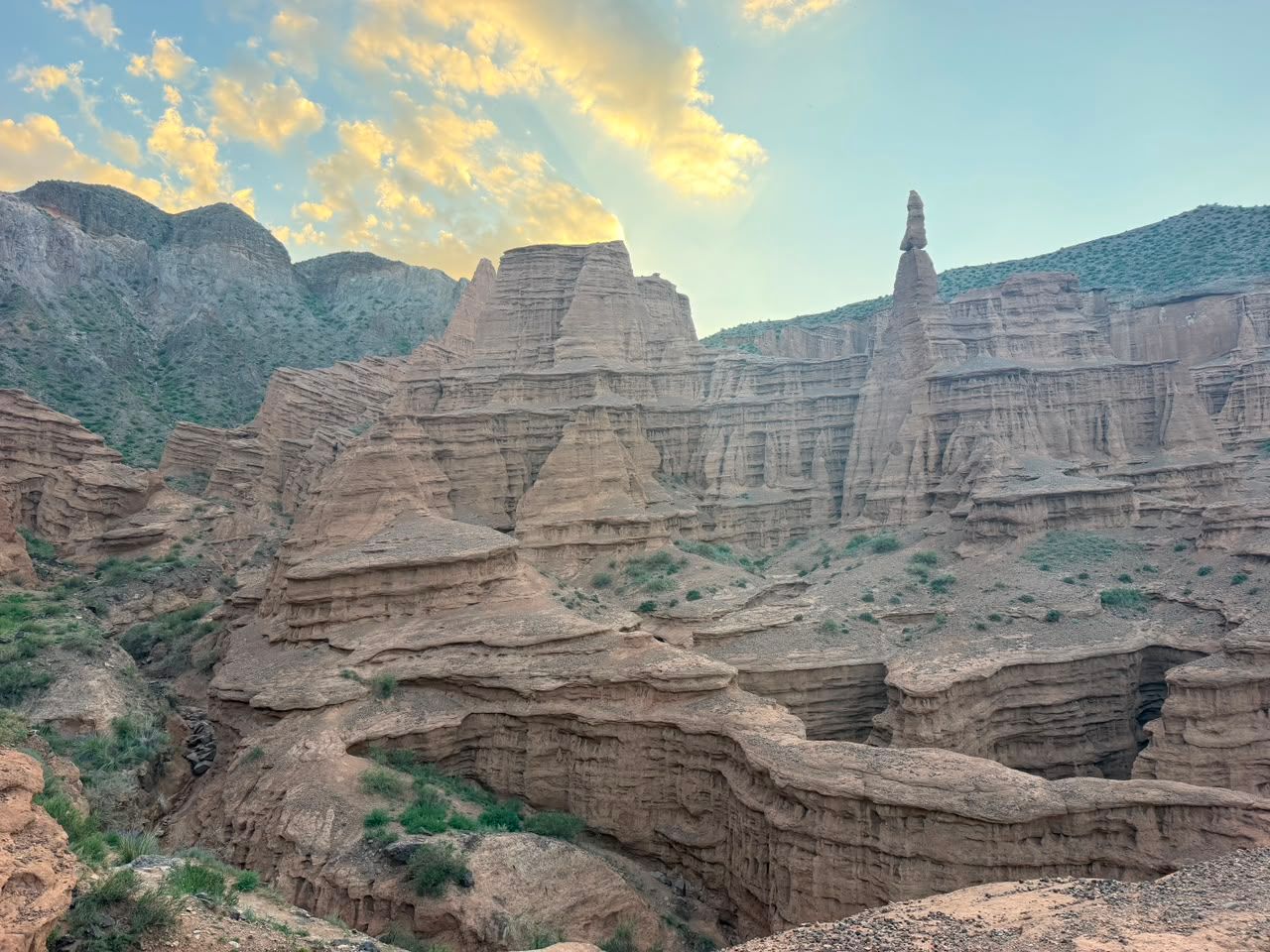
Bokonbaevo is the south shore’s working heart — a spread-out village where the tourist draw is not a beach strip but people: the bürkütchü, the eagle hunters who still take their birds into the mountains every winter. This is my home ground. I grew up on these shores, and the hunters I arrange demonstrations with are men I have known for years, not performers hired for the season. Around the village, the south shore packs in more variety per hour of driving than anywhere else on the lake: an eroded canyon, red cliffs, waterfall gorges, a village that builds yurts for half the country, and quiet lakeshore camps where the loudest sound at night is the water.
What is Bokonbaevo, and why base yourself on the south shore?
Bokonbaevo is the main service town of Issyk-Kul’s south shore, in Ton District at roughly 1,750–1,800 m above sea level, and it is the recognized center of Kyrgyzstan for eagle-hunting demonstrations. It also works as a gateway to the Terskey Ala-Too, the range that rises steeply behind the south shore, putting gorge trailheads within short drives of the lake. The village itself is modest — it was founded in 1912 as Koltsovka and renamed in 1944 for the Kyrgyz poet and playwright Zhoormart Bokonbaev — but it anchors the whole southern circuit.
The two shores of Issyk-Kul have different characters, and it is worth choosing consciously. The north shore, closer to Bishkek, is the developed resort strip: sanatoria, hotels, boat trips and nightlife around Cholpon-Ata and Bosteri, mostly serving domestic and Kazakh holidaymakers. The south shore is quieter and more village-based — eagle hunters, canyons, gorges, and beaches like Tosor that travelers consistently describe as more peaceful than the north’s. If you want an easy resort week, go north. If you want to pair lake days with culture and mountains, base yourself here. I have written the north shore and south shore compared in more detail on the Issyk-Kul page.
What happens at an eagle-hunting demonstration?
What will I actually see, and how long does it take?
A typical demonstration near Bokonbaevo lasts one to two hours and follows a recognizable arc. It begins calmly: the hunter introduces his bird and explains the training, the diet, the daily care and the relationship between them — one handler, years of work. Then the eagle is carried to a rise, often by a second man on horseback. On the signal it launches, soars, and drops onto a lure — first a static target, then a moving one dragged behind a galloping horse. Experienced handlers can often tell you in advance exactly where the bird will strike.
Many demonstrations include the wider complex: taigan hounds — the Kyrgyz sighthound, built like an Afghan hound — working on the ground, and traditional archery with a handmade bow that guests can try. The full complex of horse, eagle, taigan and archery is called salbuurun. At the end you are usually shown how to hold the eagle on a gloved fist — the classic photograph — with plenty of time for questions and pictures throughout. Some hunters hood the bird for guest holding, others do not; practices vary.
One thing to be clear about: no live prey is killed in demonstrations. The birds fly at lures and pelts — a fox skin on a rope — and no animals die for the show.
Is eagle hunting ethical?
It is a fair question, and the honest answer starts with this: eagle hunting in Kyrgyzstan is a working tradition, not only a show. The same birds you see flying to a lure in July are taken into the mountains to hunt fox and hare in winter, and the income from demonstrations is part of what keeps the practice — and the birds — supported year-round. Falconry is inscribed on UNESCO’s Representative List of the Intangible Cultural Heritage of Humanity, and Kyrgyzstan was added to that multinational inscription in December 2021.
That said, not every operation is equal. The markers of a good one: birds that are flown and exercised regularly, calm and unhurried demonstrations, hunters who put the bird’s health before the performance, and an eventual release of the eagle back to the wild to breed. Release after years of partnership is the ethical norm, though accounts vary on the timing — some say the birds are released in their first decade, others describe keeping them much longer. The hunters I work with can tell you themselves how and when they release their birds — ask them when you meet them. The red flags are equally clear: chained birds, rushed shows, and anyone offering forced hunts out of season. If a place feels staged and hurried, walk away. I have written about the bürkütchü tradition — and its ethics — in depth in the journal.
When can I see a demonstration — and what about real hunts?
Demonstrations run year-round and are normally arranged locally, a day or so ahead: guesthouses and yurt camps in Bokonbaevo book them with hunters they know, and the village’s Community-Based Tourism (CBT) office and the Salburun Federation — an organization created to preserve and support traditional hunting — can also arrange them. Real hunts are a winter affair, roughly October to February depending on the weather, done on horseback with a special armrest to carry the eagle until the hood comes off. In summer the birds molt and are flown less. Full-day ride-along hunts in season are occasionally offered, arranged on inquiry with guide, horses, lunch and transport included; ask me and I’ll confirm what a day like that runs for your group and dates.
What does a demonstration cost?
The price depends on group size and whether transport is included, and there is no official price list — bookings made through international online platforms tend to be overpriced for exactly the same experience, which is why I don’t publish figures that would just go stale. The way this market actually works is a message sent a day ahead — which is precisely how I work. Send me a WhatsApp message with your date and group size, and I will confirm a demonstration with a hunter I trust, at the local price, usually within the hour.
What else is there to do around Bokonbaevo?
Skazka (“Fairytale”) Canyon
Skazka means “fairytale,” and the small canyon of wind- and rain-carved rock just off the shore road earns the name on a first visit. It sits naturally on the drive between Bokonbaevo and Karakol, which makes it the standard pairing with a demonstration stop: eagles in the morning, an hour wandering the canyon’s formations in the afternoon, and you are still at your next camp for dinner.
Jeti-Oguz — the Seven Bulls cliffs and Broken Heart rock
Further east, at the mouth of the Jeti-Oguz valley, a row of cliffs said to resemble seven bulls — jeti-oguz means exactly that — stands over the road, with the formation known as Broken Heart rock nearby. The valley behind them leads up into the Terskey Ala-Too and is known for summer pastures and walking. Jeti-Oguz is also reachable from the Karakol side by local marshrutka, so it fits into either direction of a south-shore trip.
Barskoon gorge and its waterfalls
Barskoon cuts south from the shore road into the range, and its best-known sight is the waterfall travelers call the Maiden’s Braids. A common format here is a short horse ride up the gorge to the falls rather than a hike — a gentle half-day that suits almost anyone. If riding appeals, this is a good first taste before committing to a longer horse trekking trip higher in the mountains.
Kyzyl-Tuu — the village that builds Kyrgyzstan’s yurts
A short drive from Bokonbaevo, Kyzyl-Tuu produces wooden yurt frames at village scale — this is where a large share of the country’s yurts are born. The work divides traditionally: men make the collapsible wooden frames, women the felt coverings and patterned interiors. Yurt-construction demonstrations are visitable, and watching a frame go up — lattice walls, curved roof poles, and the tündük, the wooden crown at the top that also sits at the center of the Kyrgyz flag — gives you a new eye for every yurt you sleep in afterward. The visit combines well with felt-making workshops in Bokonbaevo itself for a craft-focused half day.
Tuz-Kol salt lake and the south-shore hot springs
Just behind the shoreline near the village, about 400 meters from Issyk-Kul’s edge, lies Tuz-Kol, a small salt lake where the water is dense enough to float in without effort — locals treat it as the region’s dead-sea swim. The south shore also has a belt of thermal springs reported at Bar-Bulak, Kadji-Sai and Juuku; facilities are simple and opening patterns informal, so ask locally rather than expecting a spa.
Lakeshore yurt camps and CBT homestays
The south shore’s signature stay is a yurt camp on the beach. Tosor, west of Bokonbaevo, is the best-known: powdery sand, a seasonal camp, and Skazka Canyon and the Barskoon valley both within easy reach. In the village itself, CBT homestays charge per person per night including meals — I don’t quote figures because they shift; confirm the current rate when you book, or ask me. The season for both is May to September. For a wider view of what a night in a yurt camp costs and includes, that site keeps a useful catalog of camps around the country.
When is the best time to visit the south shore?
For yurt camps, swimming and the canyon circuit, come between May and September, with July and August the warmest and busiest. Eagle-hunting demonstrations run year-round, so even a winter visit has a reason to stop. Early August brings the Birds of Prey festival — often called the Salbuurun festival — to the Bokonbaevo area: eagle and falcon competitions, taigan events, music and felt-craft stalls. The 2025 edition was held on 10 August at the Jaichy yurt camp near Kok-Sai, and a 2026 edition has been announced for 1 August 2026. The 2026 date rests on a single announcement so far — treat it as provisional and reconfirm locally before building a trip around it. Festival dates move year to year, so always check the current season. September has its own reward: herders bring the livestock down from the high pastures, and the roads fill with horses and sheep — slow driving, wonderful photographs. If you are planning around events, salbuurun is also a core discipline at the World Nomad Games, which return to Kyrgyzstan in 2026 — see salbuurun at the World Nomad Games. For the full month-by-month picture, see the best time for each activity.
How do I get to Bokonbaevo?
From Bishkek, count on about four to five hours by car via the Boom gorge and the south-shore road; sources disagree on the exact distance, so think in hours, not kilometers. By marshrutka from the bus station it is five to six hours; you pay a per-seat fare on board, and fares climb with inflation, so check the current figure at the station. Minibuses marked “Bokonbaevo,” “Ton” or “Tosor” leave every one to two hours through the day, and any south-shore Karakol marshrutka can drop you in the village on request. From Karakol it is about 140 km and around three hours by local transport.
| Route | Mode | Time | Cost |
|---|---|---|---|
| Bishkek → Bokonbaevo | Private car | ~4–5 h | Quoted per car on inquiry |
| Bishkek → Bokonbaevo | Marshrutka | ~5–6 h | Per-seat fare, paid on board |
| Karakol → Bokonbaevo | Local transport | ~3 h | Per-seat fare, paid on board |
If you would rather not negotiate bus stations with luggage, I arrange door-to-door transfers from Bishkek, the airport or Karakol — message me on WhatsApp and I will quote for your group.
Can I combine Bokonbaevo with the rest of Issyk-Kul in one trip?
Yes — and honestly, that is the best way to do it. Bokonbaevo sits naturally on a loop from Bishkek along the south shore to Karakol and back along the north: a demonstration and Skazka on the way east, trekking and the market town at the far end, beaches on the way home. I have sketched exactly this circuit, in 7-, 10- and 14-day versions, in the Kyrgyzstan itinerary guide. Any itinerary on this site is a sample — the final program is tailored on inquiry.
How do I book an eagle-hunting demonstration with a local guide?
The simple answer: message me. I work with bürkütchü families on the south shore whom I know personally, and I arrange demonstrations, full salbuurun programs, and — in winter, for those who ask — days out with working hunts. If you want more than a demonstration, the hunters and the craft villages of the south shore also anchor my cultural tours with the hunters I know.
Tell me your dates and what you want to see — a single demonstration on the way to Karakol, or a full south-shore loop with canyons, yurts and a lake to float in. Reach me on WhatsApp (the button on this page) or through the contact form, and I will come back with a plan and an honest local price.
Message us on WhatsApp (opens in new tab)
Contact
Want to see this place with someone who knows the road in? Message Kylych on WhatsApp with your dates and group size, or send the inquiry form — you will hear back with an honest plan, not a package pitch.