Field guide
Kyrgyzstan in 7, 10 or 14 Days
Route logic for Issyk-Kul, Song-Kul, Karakol and Tash Rabat—with realistic driving time.
Quick answer
Seven days suits one strong region. Ten days can add a seasonal mountain stay. Fourteen days gives a fuller loop—but still not the whole country.
Choose by time
Count transfers honestly before adding places.
Protect the main experience
Keep at least two nights in the base for your main activity. Do not add Song-Kul or Tash Rabat only to collect another pin.
The route rule
High roads, weather and useful stops turn short map distances into substantial travel days. The strongest itinerary removes one place before it adds another.
Sources
- Visit Kyrgyzstan — Backpacking routehttps://www.visitkyrgyzstan.org/backpacking/
- Kyrgyzstan Travel Guide 2026https://factsfromupstairs.com/travel-guide/kyrgyzstan/
I have guided travelers around Kyrgyzstan for more than fifteen years, and the question I hear most often is not “what should I see?” but “how do I fit it together?” This country looks small on the map and is not small at all — the roads are slow, the altitude is real, and the seasons decide more than any wish list. This is how I think about a route when someone tells me their dates. The day-by-day plans below are samples, not fixed products: every trip I run is tailored to the group, the month and the weather that year.
How many days do you actually need in Kyrgyzstan?
The short answer: seven days covers the Issyk-Kul loop properly; ten days lets you add Song-Kul or a serious trek; fourteen days opens Naryn and Tash Rabat, or the country’s west and south. Less than seven and you spend the trip in a car; more than fourteen and you are probably a trekker already. Here is the honest trade-off table:
| Days | What fits comfortably | What you give up |
|---|---|---|
| 7 | The full Issyk-Kul loop: Karakol, hot springs, the south shore | Song-Kul, Naryn region, anything far from the lake |
| 10 | The loop plus Song-Kul (2–3 nights), or the loop plus the full Ala-Kul trek | Tash Rabat; the west and south |
| 14 | All of the above plus Tash Rabat and Naryn — or a west/south variant (Sary-Chelek, or the Alay Valley with a flight home from Osh) | Depth in any one place; rest days |
What is the smartest route logic?
Every ranking blog will give you a list of places. What they cannot give you is the order — and in Kyrgyzstan the order is half the trip. Three decisions shape everything.
Should you go clockwise or counter-clockwise around Issyk-Kul?
My default is counter-clockwise: south shore first, north shore last. The south shore is the quiet, working side of the lake — villages, eagle hunters, canyons, yurt camps — and it rewards the fresh energy of the first days. You finish on the north shore around Cholpon-Ata, where the resorts and sandy beaches are, ending the trip with easy swim days close to the Bishkek road. Coming back along the north also puts you on the faster, busier highway for your return, when you are tired and just want to arrive. The reverse order works too — but travelers who do the north shore first often skip the south entirely because the beach is comfortable, and they miss the better half of the lake.
Why altitude decides the order
Altitude is the itinerary rule nobody puts in bold. Bishkek sits at about 750 m. Kochkor, the gateway town to Song-Kul, is around 1,800 m. Song-Kul itself is 3,016 m — higher than most ski resorts — and mild altitude symptoms like headache and poor sleep are common on arrival. So the sequence writes itself: never sleep at 3,000 m on your second night in the country. Give yourself two or three days at lake level and in the valleys first, then go up. The same logic applies to trekking: the classic Ala-Kul route is better in four days than three precisely because of acclimatization, not fitness.
North shore or south shore first?
Character answers this. The north shore is developed: resort towns, sanatoria, boat trips, nightlife, beaches full of Kazakh and Kyrgyz holidaymakers. The south shore is quieter and more village-based, with the Terskey Ala-Too range rising steeply behind it, putting trailheads and gorges minutes from the water. Culture-first travelers and trekkers belong on the south shore; families wanting an easy beach holiday belong on the north. Most good itineraries use both — which is why the loop, in either direction, beats any there-and-back route.
What does a 7-day itinerary look like?
A week gives you the whole Issyk-Kul loop at a human pace. Sample itinerary — the final program is tailored on inquiry:
- Day 1 — Bishkek. Arrive, recover, walk the city. If you land early, take the Ala-Archa day: a national park 40 km south of the capital, gentle riverside walking, the mountains without the altitude shock.
- Day 2 — Bishkek to Karakol. Take the north-shore road (the faster route, around five and a half to seven hours depending on your wheels) and stop at Burana Tower near Tokmok — a 10th–11th-century Karakhanid minaret with a field of ancient stone balbals, directly on the way. It is the easiest taste of the Silk Road and living-culture days this country does so well.
- Day 3 — Karakol. The town itself: wooden houses, the Dungan mosque built without a single nail, ashlyan-fu noodles at the bazaar. If it is Sunday, the animal market runs early — be there by 8 am, it is over by 10.
- Days 4–5 — Altyn Arashan. Up to the hot-springs valley at about 2,600 m: hike the 15 km from Ak-Suu (four to six hours) or take a Soviet 4x4 up one of the roughest roads you will ever ride. Soak, sleep in a yurt or guesthouse, come back down.
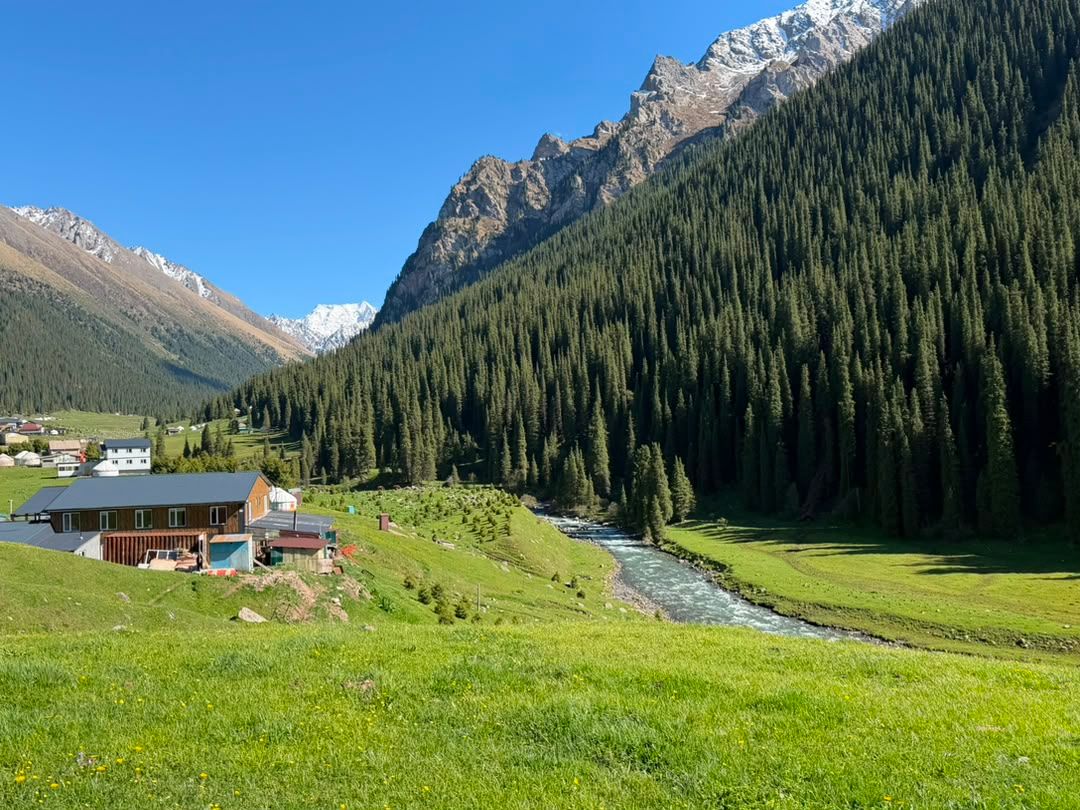
- Day 6 — South shore. Drive the south-shore road west: Jeti-Oguz’s red cliffs, Skazka Canyon, and Bokonbaevo for an afternoon with an eagle hunter and his golden eagle. Overnight in a village guesthouse or a lakeshore yurt camp.
- Day 7 — Return to Bishkek along the lake.
What do the extra three days buy you in a 10-day itinerary?
The honest answer: Song-Kul — or a real trek. Both are shown as samples.
Variant A — Song-Kul. From Bishkek, drive about four hours to Kochkor, then two and a half more on a rough dirt road over the Kalmak-Ashuu pass (3,446 m, 4x4 only) to the lake at 3,016 m. Two to three nights in a shepherd-run yurt camp: horses, kymyz, cold nights, stars with no light pollution. The season is strict — camps operate June to early September and the road deteriorates after mid-September — so this variant exists only in summer. The finer way to arrive is on horseback: the classic multi-day horse trek to Song-Kul rides from Kyzart over two passes to the lake in two days, sleeping in shepherd yurts on the way. See the Song-Kul guide for the season mechanics.
Variant B — the Ala-Kul trek. Instead of one night at Altyn Arashan, take the full route from Karakol: up the Karakol valley to the turquoise lake at about 3,500 m, over a pass of roughly 3,900 m, and down into the Altyn Arashan hot springs — 40–50 km over three to four days, best from early July to mid-September. I recommend four days; your knees and your head will agree. This is the guided trek over the Ala-Kul pass I have walked more times than any other route.
What does a 14-day itinerary add?
Two weeks adds Naryn region — the heartland — or takes you off the Issyk-Kul axis entirely. The natural extension follows Variant A: after Song-Kul, continue south to Naryn town and on to Tash Rabat, a 15th-century stone caravanserai at about 3,200 m where Silk Road caravans once sheltered on the road to Kashgar. The ruined 10th–11th-century fortress of Koshoy Korgon is on the way, and you can sleep in a yurt beside the caravanserai itself. Alternatively, add Jyrgalan, the valley an hour east of Karakol, for two or three days of jailoo walking.
Two bigger variants deserve a mention but not a full plan here — talk to me if either calls to you. The west: Sary-Chelek, a UNESCO Biosphere Reserve of walnut forests and a deep mountain lake — superb low-impact nature travel, but honestly a long transfer, around nine hours from Bishkek by public transport. The south: fly or drive to Osh, continue to the Alay Valley and the yurt camps at Tulpar-Köl beneath the 7,134 m wall of Lenin Peak, and fly home from Osh instead of backtracking. Both need careful sequencing; both are worth it.
When should you come for these routes?
Everything above except the cultural stops is seasonal. The honest summary, activity by activity:
| Activity | Window | Caveats |
|---|---|---|
| High-route trekking (Ala-Kul and similar) | mid-June – mid-September | July–September most reliable; passes can hold snow into July |
| Song-Kul yurt camps | June – early September | One camp publishes 4 June – 28 September; road tricky after mid-September |
| Issyk-Kul swimming | June – early September | Water around 20–24 °C in July–August |
| Horse trekking | June – September | Same jailoo season as the camps |
| Skiing and ski touring | mid-December – late March | Karakol runs December–March; Jyrgalan freeride January–March |
| Eagle-hunting demonstrations | Year-round | Real hunts are October–February; festivals in early August |
| Cultural touring | Year-round | Spring mud on country roads; autumn golden and quiet |
One date to circle for 2026: the World Nomad Games run 31 August – 6 September, with the main competitions on Issyk-Kul’s north shore — if your trip lands then, build around it. My when-to-go guide has the full month-by-month picture.
How do you get around on these routes?
Think in hours, not kilometres — sources disagree on distances, and mountain roads have their own pace. The legs you will actually drive: Bishkek to Cholpon-Ata about four hours; Bishkek to Karakol six to seven hours by marshrutka, around five and a half in a private car; Bishkek to Kochkor about four hours, then two and a half on dirt to Song-Kul. Marshrutkas are cheap — fares move year to year, so confirm the current one at the bus station — but they leave when full, not on a timetable, make no stops at canyons or viewpoints, and cannot go up to Song-Kul or Altyn Arashan at all. A private driver costs more and buys you exactly those stops, those trailheads and your own schedule. On my trips I arrange door-to-door transfers throughout, which is why my guests never learn how full a marshrutka gets.
If you are weighing these routes against your dates, send me a WhatsApp message using the button on this page with your arrival day and group size — I will tell you what fits.
How much do these itineraries cost?
I do not publish prices, because a price that is out of date is worse than no price at all: transport fares, yurt-camp rates and guide day-rates all move with the season, and every trip I run is tailored to the group, the month and the route. The honest short version is that Kyrgyzstan is affordable by any Western measure, and the biggest cost lever is not accommodation or food — it is how you move. Tell me your dates and group size on WhatsApp and I will give you a current figure for your exact route.
Can you do these routes outside summer?
For Song-Kul and the high treks, plainly no: the yurt camps strike from mid-September, the passes close with the first snows, and no honest operator will sell you a November Song-Kul trip. But the country does not close. Karakol and Jyrgalan become a winter base — ski touring around Karakol runs December to March in a valley locally regarded as the snowiest in the region — and the cultural side of every route above works year-round: Bishkek, Karakol town, the south shore’s canyons and eagle hunters, Burana. Autumn is also the start of hunting season in the high mountains — regulated expeditions with permits and fixed seasons, explained here.
Do you need a visa for 7–14 days?
For many travelers, no. As of July 2026, citizens of 55 countries — including most of Europe, the UK, the USA, Canada and Australia — get 30 days visa-free within each 60-day period, a rule tightened from the previous 60 days at the end of 2025; either way, a 7–14-day trip fits inside it. Russian citizens enter visa-free entirely, and several other nationalities use an e-visa. Rules in this region change with little notice, so treat this paragraph as dated and check the current rules on my visa and entry page before you book flights.