
Destinations
Tash Rabat, with enough time to understand the place.
A 15th-century stone caravanserai in a high valley.

- Season
- May—September
- Base
- Naryn
- Pace
- 1—2 days
Go for the place—not only the landmark.
The strongest visit leaves room for local conditions, short walks and the road itself.
- Use one practical base instead of changing hotels every night.
- Match outdoor plans to the season before fixing transfers.
- Leave margin for mountain roads, weather and unplanned stops.
Build a route that still feels like a journey.
Pair nearby places before adding another distant region.
Song-Kul
A sensible companion when dates and road conditions allow.
Bokonbaevo & south shore
A sensible companion when dates and road conditions allow.
Lenin Peak & Alay
A sensible companion when dates and road conditions allow.
What to decide before you go
Access
Mountain roads take longer than the map suggests; confirm the current approach.
Stay
Choose the base around the next day's activity, not only the best-known town.
Conditions
Weather, road work and seasonal camps can change the final plan.
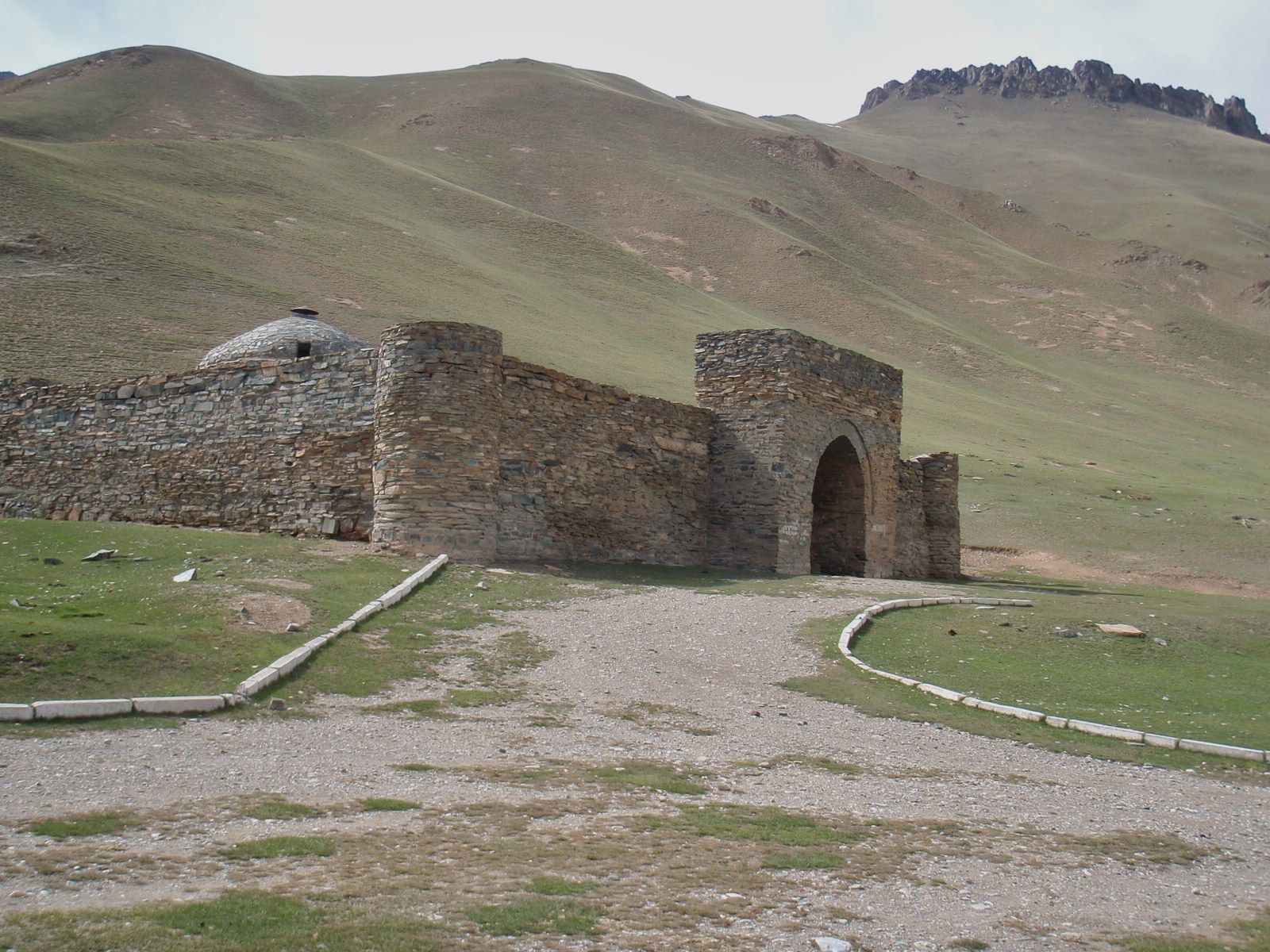
Five centuries ago, the caravans that crossed the Torugart Pass between the Fergana and Chui valleys and Kashgar needed somewhere to shelter from snowstorms and bandits before the final climb to the Chinese border. One of those shelters still stands. Tash Rabat — the name means “stone inn” — sits alone in a high valley south of Naryn, a low fortress of dark stone built half into the hillside, and it is one of the most atmospheric historic sites in Kyrgyzstan. It is also genuinely remote: there is no public transport, the last stretch is unpaved, and at over 3,000 metres the weather has its own ideas. This guide covers what the building is, how to get there, what it costs, and how to combine it with Song-Kul or a Torugart crossing.
What is Tash Rabat?
Tash Rabat is a 15th-century stone caravanserai in the At-Bashy district of Naryn Region, conventionally dated to the 1400s and unusually well preserved — it was completely renovated in 1984. It is one of only two surviving caravanserais on the Kyrgyz Tien Shan branch of the Silk Road (the other, Manakeldy near Chaldyvar, survives in far poorer condition). The building is a single-storey, fortress-like structure of rubble stone, partly built into the slope of the Kara-Koyun valley. You enter through a monumental pointed-arch portal flanked by corner towers; inside, rooms and chambers run off a central corridor around a domed former prayer hall. The smaller rooms served as sleeping quarters and pantries, and one is traditionally described as a dungeon. The structure contains a well and — reportedly — escape tunnels into the hillside. A chest-high wall rings the flat roof.
What makes Tash Rabat unusual among caravanserais is its isolation. These roadside inns were normally spaced a day’s march apart in settled country; this one sits alone in empty mountains at over 3,000 metres, on the direct caravan route over the Torugart Pass to Kashgar. For deeper reading on the Silk Road world it belonged to, silkroadkg.com covers the history of the routes and their surviving sites.
Was it really a Nestorian monastery?
Possibly — but nobody knows, and you should treat any guide who states it as fact with suspicion. Research by the Institute of History of the Kyrgyz Academy of Sciences in the late 1970s and early 1980s concluded that the building may have originated as a 10th-century Nestorian Christian monastery, later converted to a caravanserai. The catch: excavations found no Christian artefacts. An even earlier hypothesis, put forward by the Russian traveller N. Zeland in 1888, suggested a Buddhist monastery. The honest summary is that the building’s origins are an open scholarly question. The 15th-century caravanserai dating is the conventional one; the older religious origin is a genuine mystery, not an established fact.
Is Tash Rabat a UNESCO World Heritage site?
No — and this is worth stating plainly, because many websites get it wrong. Tash Rabat is on UNESCO’s Tentative List as part of “Silk Roads Sites in Kyrgyzstan” (ref. 5518), which means Kyrgyzstan has proposed it for future nomination. It is not part of the inscribed 2014 World Heritage property “Silk Roads: the Routes Network of Chang’an–Tianshan Corridor” — Kyrgyzstan’s three component sites in that listing are all former cities of the Chui valley (Balasagun/Burana, Suyab and Navekat). Tentative-list status still tells you something real: this is one of the country’s most significant surviving Silk Road monuments. It just isn’t World Heritage yet.
Where is Tash Rabat and how do I get there?
Tash Rabat lies about 110 km south of the town of Naryn — most sources give roughly this figure, though published estimates range from about 80 to 115 km — in the Kara-Koyun valley, a side valley off the A365 highway that runs from Naryn toward the Torugart border. Allow around two to two and a half hours from Naryn. The turn-off leaves the paved highway for the final 15 km or so of unpaved track up the valley.
The important practical fact: there is no public transport to Tash Rabat. No marshrutka, no bus. Visitors come by private car or, more commonly, by car with a driver arranged through operators in Naryn or Bishkek — CBT Naryn is the long-standing community-tourism option. The site is at about 3,200 metres (published figures vary; “over 3,000 m” is the safe way to think about it), so even the drive up earns you some altitude.
This is the honest point where I say: we drive this road ourselves. If you want Tash Rabat without negotiating drivers in Naryn or worrying about the unpaved last stretch, send me a message on WhatsApp — the button is on every page — and tell me your dates.
Do I need a permit to visit Tash Rabat?
No permit is needed for the caravanserai itself. You can drive up, pay the entrance fee and walk in.
A border-zone permit is required for anything that approaches the Chinese border zone: the hiking and horse trails over the At-Bashi range down to Chatyr-Kul lake — including the route over the Tash Rabat pass at 3,964 m — and any trip toward the Torugart border itself. These permits must be arranged in advance, typically through operators in Naryn. One operator-practice note, not an official rule: some travellers report lead times of two to three weeks for border permits arranged through operators, so don’t leave it to the last minute. The exact mechanics — which authority issues them, current processing times and cost — are something I arrange as part of a trip rather than something travellers should have to decode from outdated websites.
How much does it cost to visit?
Entrance to the caravanserai carries a modest fee, payable at the site — I don’t quote a figure here because these fees change and online figures go stale fast; the current rate is posted on arrival, or ask me and I’ll confirm it before your visit. Yurt-camp overnight prices beside the site aren’t published here because I don’t have verified current figures; ask when you inquire and I’ll quote you the real number for your dates. The larger cost of a Tash Rabat visit is the transport, not the ticket — which is why it makes sense to combine it with Song-Kul, Naryn or a Torugart itinerary rather than drive south for the building alone.
When is the best time to visit Tash Rabat?
Realistically June to September. CBT Naryn gives May–September for the Tash Rabat–Torugart circuit, and the yurt camps beside the caravanserai operate roughly from the start of June to the end of September, with July and August the peak. Outside that window the access track is snow-affected and the camps are gone. Even in midsummer, remember the altitude: at over 3,000 metres, nights are cold year-round, so bring proper layers even if Naryn was hot at lunchtime. For a month-by-month picture of how Tash Rabat fits the wider year, see our guide to the best season for each activity.
Can you sleep at Tash Rabat?
Yes — and you should, if your itinerary allows it. Yurt camps operate beside the caravanserai through the summer season, and the site caretaker also offers accommodation in boz-uy (traditional felt houses). Facilities are basic, as they are at every high-altitude camp in Kyrgyzstan: expect simple bedding, simple food, limited washing facilities and no reliable phone signal.
The reason to stay is the one the site itself gives you. Tash Rabat stood directly on the Torugart caravan route; the merchants who crossed the pass slept within these walls or in tents beside them. Sleeping in a yurt a few metres from a 15th-century stone inn, in a valley that goes properly dark and silent at night, is about as close as travel gets to time travel. It’s the kind of night my guests tend to remember longer than the famous places.
What else is there to see nearby?
Two stops combine naturally with Tash Rabat:
- Koshoy Korgon — the ruined walls of a 10th–11th-century fortress in the Kara-Suu valley, on the route north back toward Naryn. Far less intact than Tash Rabat, but free, rarely visited, and a useful piece of the same Silk Road story.
- Chatyr-Kul — a high lake at about 3,500 m, some 20 km south of Tash Rabat beyond the At-Bashi range. It sits inside the border zone, so visiting requires the border permit described above, arranged in advance.
The classic Naryn day circuit run by local operators strings these together: Naryn → Koshoy Korgon → Tash Rabat → Chatyr-Kul → toward the Torugart border and back — a long day of roughly 520–560 km by 4x4 or minivan, May to September, with the border permit needed for the Chatyr-Kul section. Driving in from Bishkek, the road east crosses the Chui valley and its older Silk Road sites — our sister site covers Burana Tower, the other Karakhanid stop on the route, a natural first or last stop on the same journey.
How do I combine Tash Rabat with Song-Kul?
Song-Kul and Tash Rabat are the standard pairing for the Naryn region, and for good reason: one gives you the living nomadic present — shepherd yurt camps on the summer jailoo around the lake — and the other gives you the Silk Road past. The usual shape is two to three days at Song-Kul, then south to Tash Rabat either via Naryn or on the rougher, more scenic track from Baetov over the MELS (Borulu Ashuu, 3,262 m) and Kulak Ashuu (3,390 m) passes — that route is 4x4-only and not for a hire saloon. See our Song-Kul destination guide for the lake side of the trip.
Some operators also offer a multi-day horse traverse between the lake and the caravanserai — roughly 120 km over high passes, typically quoted as about three days. I’d flag this as the kind of route that needs confirming on the ground before I promise it: if a horseback crossing from Song-Kul to Tash Rabat is what you’re dreaming of, ask me and we’ll work out the routing together. Any itinerary we build from these pieces is a sample — the final programme is tailored on inquiry.
What about Torugart and the road to Kashgar?
Tash Rabat is the natural overnight stop between Naryn and the Torugart border crossing at 3,752 m — historically, it was exactly that for the caravans, which is why it exists. The modern crossing, though, cannot be done independently. Since the border reopened to tourists in 2023, Torugart has operated on a certified-operator rule: permission must be pre-arranged on the Chinese side, a representative of a recognised Chinese travel company must meet you at the border, and the crossing is closed on weekends and on the public holidays of either country (and can close at short notice for weather in any month). First-hand accounts put the full process at around five hours of checkpoints and buffer zones. In short: it’s a serious logistical undertaking, not a viewpoint you drive up to. If Kashgar is your goal, this is exactly what our Silk Road cultural tours handle — Kyrgyz-side permits, transport and timing, coordinated with the mandatory Chinese-side arrangement.
How do I visit Tash Rabat with Kylych?
Tash Rabat rewards travellers who give it context — the building, the jailoo country around it, and the road it guarded. On my trips it usually anchors the southern end of a Song-Kul journey, with Koshoy Korgon on the way and, for those continuing to China, a coordinated Torugart crossing after it. Because there’s no public transport and the season is short, dates matter: the camps come down in September and the road follows.
Tell me when you’re travelling and how many days you have, and I’ll shape the route around the season and the road conditions as they actually are — message me on WhatsApp using the button on this page, or send an inquiry through the contact page. If you can, include whether you’d like to sleep at the caravanserai: it’s the detail that changes a good visit into a memorable one.
Message us on WhatsApp (opens in new tab)
Contact
Want to see this place with someone who knows the road in? Message Kylych on WhatsApp with your dates and group size, or send the inquiry form — you will hear back with an honest plan, not a package pitch.