
Destinations
Kel-Suu, with enough time to understand the place.
A remote lake in the Kok-Kiya valley near the Chinese border — permits, season and honest access advice.
- Season
- July—September
- Base
- Naryn
- Pace
- 2—3 days
Go for the place—not only the landmark.
The strongest visit leaves room for local conditions, short walks and the road itself.
- Use one practical base instead of changing hotels every night.
- Match outdoor plans to the season before fixing transfers.
- Leave margin for mountain roads, weather and unplanned stops.
Build a route that still feels like a journey.
Pair nearby places before adding another distant region.
Tash Rabat
A sensible companion when dates and road conditions allow.
Song-Kul
A sensible companion when dates and road conditions allow.
Issyk-Kul
A sensible companion when dates and road conditions allow.
What to decide before you go
Access
Mountain roads take longer than the map suggests; confirm the current approach.
Permit
Kel-Suu sits in the Chinese border zone; the permit must be arranged in advance.
Conditions
Weather, road work and seasonal camps can change the final plan.
Kel-Suu is the lake people show me on their phones when they ask “is this real?” It is — but it is also one of the most logistically demanding places on this site, and I would rather tell you that on the page than on the road. It lies deep in Naryn region, close to the Chinese border, inside the border zone that requires a permit arranged in advance, and the season when you can reach it at all is short. This page is the honest version: what the lake is, what the permit situation really means, when to go, and how it combines with the places around it.
What is Kel-Suu?
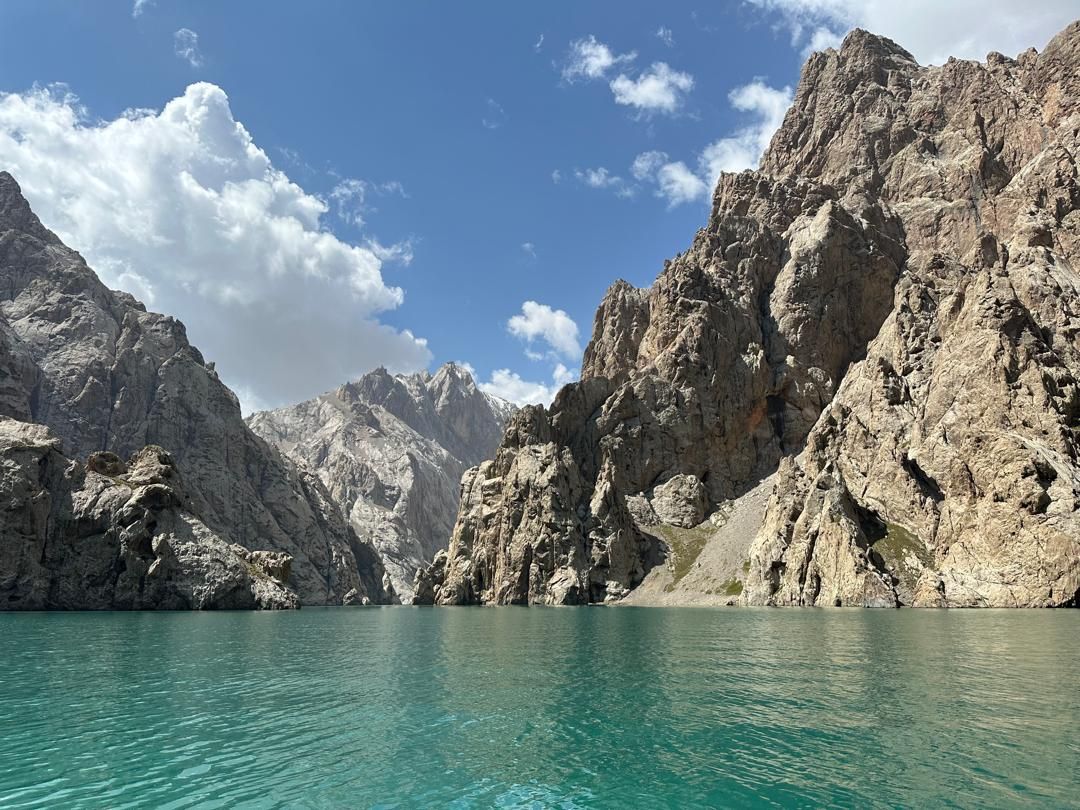
Kel-Suu is a high mountain lake in the Kok-Kiya valley in Naryn region, in the border zone near the Chinese frontier. The water is a startling turquoise, held in a steep rocky cirque — I can vouch for that much from standing there myself, and my own photographs are on this page. Beyond that, I will be careful: this lake is surrounded by traveler lore, and some of the things you will read about it elsewhere are not things I can verify. Where I cannot back a claim, I say so rather than repeat it.
Do I need a border permit for Kel-Suu?
Yes — this is the single most important fact on this page. Kel-Suu lies inside the border zone near the Chinese border, and a border-zone permit is required to visit. This is not a soft recommendation: travelers without border permits are genuinely stopped, and the guidance I trust warns that foreigners without them “do get arrested from time to time.” The permit must be arranged in advance — operators who run this route allow roughly two to three weeks for the paperwork, so a Kel-Suu trip cannot be a last-minute decision.
When you travel with me, the permit is part of what I arrange — but “arranged” only works if you write to me early. Tell me your dates as soon as you have them, and the paperwork runs while you plan the rest.
When is the best time to visit Kel-Suu?
July to September. Outside that window, snow or flooding often limits access — I have seen operator guidance narrow the reliable season even further, to roughly mid-July through the start of September. Treat June and October as unlikely, and treat even the core window as weather-dependent: this is a high valley, and conditions decide more here than the calendar does. For how Kel-Suu fits the wider year, see the best time for each activity page.
How do you get to Kel-Suu?
From the north, routes run via Naryn — the regional capital and the practical base for this part of the country — and then south on rough mountain track into the Kok-Kiya valley. The last stretch is serious road: I drive it in a proper 4x4, and I would not attempt it in an ordinary car. There is also a grander way in: horse expeditions run between Song-Kul and Kel-Suu, crossing the high country between the two lakes over multiple days — the journey itself becomes the point.
Either way, this is not a place you improvise. There is no fixed timetable to build around, no town at the lake, and the permit clock starts before the road does. A realistic visit from Naryn takes two to three days, and I build it as part of a wider Naryn-region route rather than a single out-and-back — see the pairings below.
Can you combine Kel-Suu with Song-Kul and Tash Rabat?
Yes — that combination is exactly how this corner of the country is usually traveled, and for good reason: Song-Kul and Tash Rabat lie on the way. A horse expedition links Song-Kul with Kel-Suu directly, and Kel-Suu pairs naturally with the Tash Rabat caravanserai for travelers continuing through the Naryn region. My honest advice: give the combination real days. Kel-Suu at the end of a rushed itinerary is a permit, a long drive and a worry; Kel-Suu with time around it is the reason people come to Kyrgyzstan.
How do I plan a Kel-Suu trip?
Start earlier than you think you need to — the border permit lead time sets the calendar, not the road. Tell me your dates and group size through the contact form or on WhatsApp (the button on this page reaches me directly), and I will tell you honestly whether your window fits the season, arrange the permit, and build the route around the places that pair well with the lake. As everywhere on this site, I do not publish fixed prices — every program is built separately and quoted on inquiry.
Message me on WhatsApp (opens in new tab)
Contact
Want to see this place with someone who knows the road in? Message Kylych on WhatsApp with your dates and group size, or send the inquiry form — you will hear back with an honest plan, not a package pitch.